.svg)


.png)
September 10, 2026
Subscribe on: RSS | SPOTIFY | APPLE PODCAST | GOOGLE | BREAKER | ANCHOR
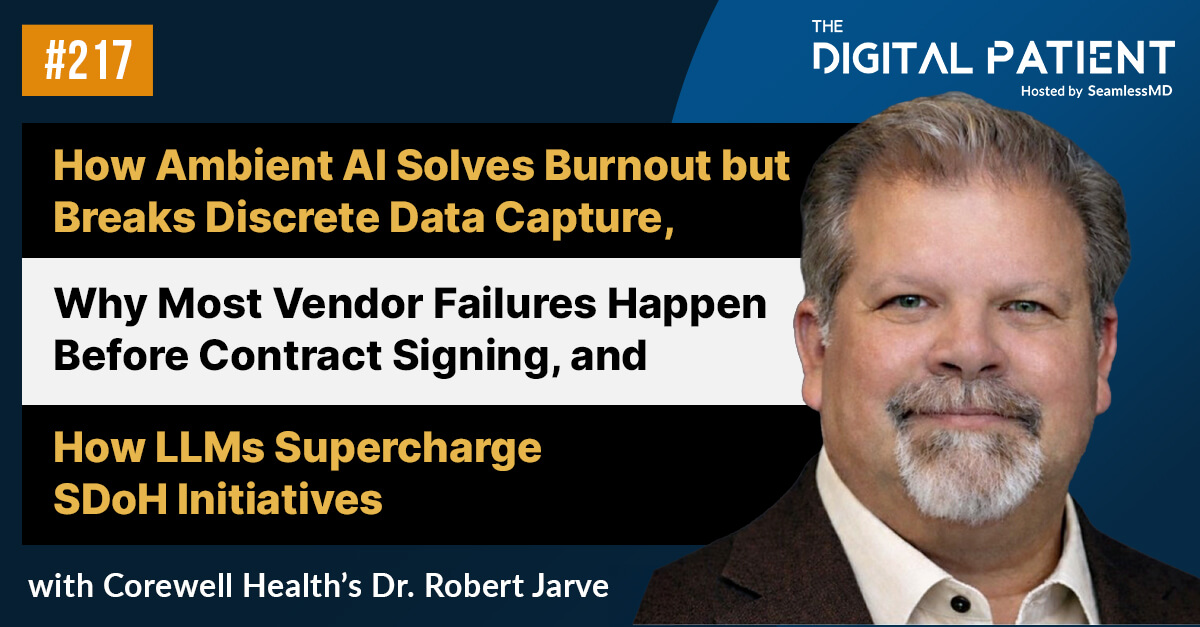
On this episode of The Digital Patient, Dr. Joshua Liu, Co-founder & CEO of SeamlessMD, and colleague, Alan Sardana, chat with Bob Jarve, MD, MBA, MSc, FAAP, FACP, Associate Chief Medical Information Officer of Population Health at Corewell Health, about "How Ambient AI Solves Burnout but Breaks Discrete Data Capture, Why Most Vendor Failures Happen Before Contract Signing, How LLMs Supercharge SDoH Initiatives, and more..." Click the play button to listen or read the show notes below.
Audio:
Guest(s):
- Robert Jarve, MD, MBA, MSc, FAAP, FACP, Associate Chief Medical Information Officer of Population Health at Corewell Health
- Joshua Liu, MD, Co-founder & CEO at SeamlessMD
Episode 217 - Show Notes:
[00:00:07] Episode preview
[00:07:44] Why confusing complex and complicated problems causes healthcare technology failures, and how vendors excel at scalable “complicated” problems but struggle with localized clinical complexity.
[00:08:50] How hospital workflows, care teams, and clinical data evolve uniquely over time, making most clinical and population health challenges complex rather than transferable across systems.
[00:10:11] What happens when health systems apply cookie-cutter vendor solutions to complex clinical problems, and why this often leads to failed implementations and wasted investment.
[00:10:58] How Corewell Health builds population health data models in-house to preserve governance, nuance, and person-level connectivity across clinical, operational, and social data.
[00:12:50] Why repeated vendor failures led to a clearer framework for deciding when to build internally versus buy externally.
[00:13:30] How distinguishing between industry-standard data and locally created data quickly determines whether a problem can be standardized or must remain customized.
[00:15:01] Why EHRs were designed for episodic operational reporting rather than longitudinal population health, requiring major rework to support trending, prediction, and AI.
[00:16:17] How data collection shortcuts, workflow design, and discomfort with sensitive questions introduce bias into race, ethnicity, and SDOH data.
[00:17:57] Why incomplete SDOH screening creates systematic blind spots, and how early screening strategies unintentionally excluded the highest-risk patients.
[00:19:14] What the Optum risk prediction failure revealed about bias in utilization-based models and why social determinants often predict risk better than medical data alone.
[00:21:48] How Corewell uses census tract data, area deprivation index, and CMS vulnerability index as scalable proxies when patient-level SDOH data is incomplete.
[00:26:03] Why ambient AI has dramatically improved clinician joy while creating new challenges for capturing discrete quality, reporting, and population health data.
[00:27:22] How natural language processing and large language models are being used to extract diagnoses and SDOH from unstructured notes to rebuild discrete data at scale.
[00:31:49] Why the CMIO role has not followed a linear evolution, and how frontline EHR optimization and population-level analytics require fundamentally different skill sets.
[00:40:10] How a readmission reduction initiative showed that simple, clinically intuitive variables—like whether a patient has a primary care physician—can outperform complex black-box models.
[00:42:50] Why black-box risk scores fail clinician trust, and how focusing on modifiable risk drivers enables actionable interventions and scalable ROI.
[00:45:22] How rapidly housing homeless patients improved medication adherence, nutrition, chronic disease control, and reduced ED and inpatient utilization.
[00:51:37] Why addressing upstream social needs like housing costs less than downstream medical care, and how ED utilization has become a de facto universal healthcare system.
Fast 5 Lightning Round:
- What is your favorite book or book you’ve gifted the most?
Trauma Stewardship by Laura van Dernoot Lipsky. - If you could instantly master any skill, what would it be?
Python coding. - Would you rather have Super strength, super speed, or the ability to read people’s minds?
Super speed. - What is something in healthcare you believe others might find insane?
"How fragmented and uncoordinated healthcare is..." - What is the last movie or TV show you saw, and what did you think of it?
Star Trek Generations. Perhaps the worst movie I've ever seen!
The Digital Patient has been recognized as Feedspot's #1 Patient Engagement Podcast of 2025. Thank you to our listeners for making this happen!
.png)
.png)


.png)
