Digital Patient Podcast

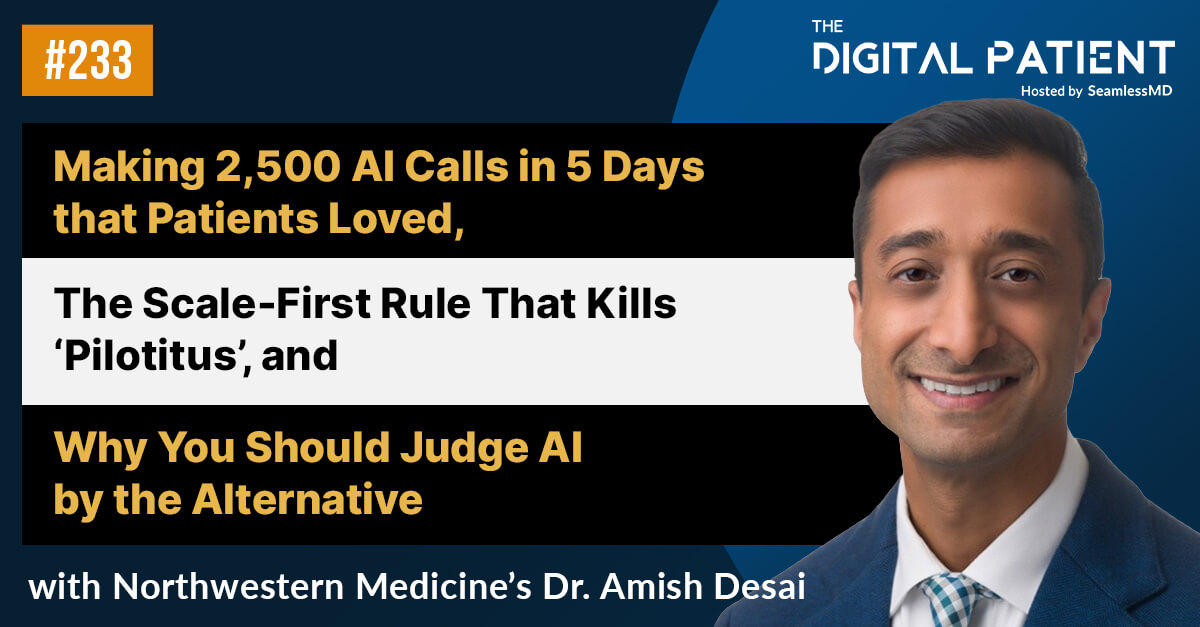
233: Northwestern's CMO, Pop Health Dr. Amish Desai: Making 2,500 AI Calls in 5 Days that Patients Loved,  The Scale-First Rule That Kills Pilotitus, and Why You Should Judge AI by the Alternative

July 23, 2026
By
seamless

Subscribe on: RSS | SPOTIFY | APPLE PODCAST | GOOGLE | BREAKER | ANCHOR

On this episode of The Digital Patient, Dr. Joshua Liu, Co-founder & CEO of SeamlessMD, and colleague, Alan Sardana, chat with Amish Desai, MD, MSc, Chief Medical Officer, Population Health at Northwestern Medicine, about "Making 2,500 AI Calls in 5 Days that Patients Loved,  The Scale-First Rule That Kills Pilotitus, Why You Should Judge AI by the Alternative, and more..." Click the play button to listen or read the show notes below.

Audio:

Guest(s):

  • Amish Desai, MD, MSc, Chief Medical Officer, Population Health at Northwestern Medicine
  • Joshua Liu, MD (@joshuapliu), Co-founder & CEO at SeamlessMD

Episode 233 - Show Notes:

[00:00:07] Episode preview

[00:06:38] What working across Iora, Erie, Oak Street, Hopscotch, and Northwestern taught him — each setting forced a different answer to how care is designed, who it's designed for, and who it leaves out. Iora grounded him in challenging norms that were "dressed up as best practice" and in "restoring humanity to healthcare" through relationships and health coaches.

[00:08:07] How Erie and Oak Street shaped his focus on the underserved — Erie's vulnerable, undocumented, and managed-Medicaid population taught him about social determinants and moving the needle incrementally with limited resources, while Oak Street brought operational rigor and scale to senior care.

[00:09:28] The pull of fee-for-service at a large academic system — at Northwestern, "gravity back to fee-for-service can just pull you," and the work is driving value-based care while acknowledging both sides of the aisle and the challenges hospital partners feel.

[00:10:56] Why high-quality primary care needs investment but not endless venture capital — a commitment to investment is essential, but CMS-led models and prospective payments can seed a "virtuous cycle" rather than requiring a long ramp of VC-backed boards.

[00:12:14] Why home-based care still matters in the telemedicine era — technology can't solve it fully, and the presence of "someone holding your hand, someone putting a stethoscope still on to build trust" goes a long way; home-based teams and community paramedicine "go the last mile."

[00:14:09] What caring for his late father revealed about the system — the gap between what lives in the chart and what patients really need, the emotional labor of caregiving, and the reminder that "a task is not a task, it's a promise to follow up."

[00:16:29] How he keeps population health grounded in the individual — he still sees patients half a day in a data-driven, segmented way, and elevates individual "love stories," like a transitional nurse going above and beyond to make sure a discharged patient actually received home oxygen.

[00:18:31] Why the patient experience is humbling even for the health-literate — despite clinical training, resources, and access, he and others still faced confusion, anxiety, and fear, a reminder of how much harder it is for the 99% of patients who lack that literacy.

[00:20:00] How leaders should decide where to apply AI — start with the friction and low-value work, not the hype. Drawing on The Human Element's fuel-versus-friction concept, target burdensome tasks like prior auths, leaving voicemails, and pulling data between systems that don't talk to each other.

[00:25:14] The biggest resistance to AI adoption — earning trust that AI can handle even the low-value work, addressing data privacy, and being honest about what AI can't do; every pilot must be co-designed with frontline staff and able to scale to tens of thousands of patients, or it isn't worth running.

[00:27:34] How agentic AI transformed annual wellness visit outreach — an end-of-year blitz made 2,500 calls in five days, patients "didn't hate it" and were more than fine talking to the AI (one agent even sang happy birthday), and the model is now being tested for transitions of care and lung cancer screening outreach.

[00:30:08] The framework of automating tasks while amplifying relationships — when a moment is transactional rather than a "relationship moment," automate it, freeing community health workers, nurses, and physicians to work at the top of their scope and invest in trust-building and clinical excellence.

[00:31:34] Where technology risks widening the digital divide — challenge ageist assumptions, since older patients are constantly on their phones, but acknowledge real digital gaps for unhoused and phone-only patients, and measure outcomes across race, ethnicity, language, and SOGI so risk-stratification algorithms don't leave people behind.

[00:34:22] What the voice-agent data shows so far — anchored mainly on Medicare patients, engagement has been decent and likelihood-to-recommend lands in the "eight, nine range out of 10," though there isn't yet enough experience across other populations to generalize.

[00:36:46] How he vets AI before and after deployment — a Patient Family Advisory Council (PFAC) advises before launch, and both patient and care-team experience are measured, framed by the idea of "judge me by the alternative," since the status quo often misses patients entirely.

[00:39:07] Why engagement must be multimodal — like a hospital website that only 90% of patients can access, a voice agent won't reach everyone, so AI can handle the 80–90% while care teams focus their limited time on reaching the remaining 10%.

[00:39:25] What high-performing care models understand about human behavior — time and trust matter. A JAMA study found reduced time pressure in primary care yields more comprehensive care, more captured conditions, and better diagnosis; lasting behavior change comes from longitudinal relationships, deep humility, and a willingness to pivot rather than short-horizon quick fixes.

[00:43:25] His closing reminder to the audience — this work is high-stakes because it's people's health, but it should also be fun and messy, and protecting your wellbeing and outside relationships is what fuels you to sustain it.

Fast 5 Lightning Round:

  1. What is your favorite book or book you’ve gifted the most?
    When Breath Becomes Air by Paul Kalanithi
  2. If you could instantly master any skill, what would it be?
    "For my wife, probably cooking... I would love to really be good at it (but not as good as her of course)"
  3. Would you rather have Super strength, super speed, or the ability to read people’s minds?
    "Mind reading."
  4. What is something in healthcare you believe others might find insane?
    "We're gonna come to a place where we realize that the specialist or the specialty care, a lot of it will become democratized into a sort of like a generalist framework... it's gonna move more upstream and be democratized in a way that I think we've never seen before."
  5. What is the last movie or TV show you saw, and what did you think of it?
    "Paradise on Disney+ is awesome"

The Digital Patient has been recognized as Feedspot's #1 Patient Engagement Podcast of 2025. Thank you to our listeners for making this happen!

233: Northwestern's CMO, Pop Health Dr. Amish Desai: Making 2,500 AI Calls in 5 Days that Patients Loved,  The Scale-First Rule That Kills Pilotitus, and Why You Should Judge AI by the Alternative

Posted by:
seamless
on
July 23, 2026

Subscribe on: RSS | SPOTIFY | APPLE PODCAST | GOOGLE | BREAKER | ANCHOR

On this episode of The Digital Patient, Dr. Joshua Liu, Co-founder & CEO of SeamlessMD, and colleague, Alan Sardana, chat with Amish Desai, MD, MSc, Chief Medical Officer, Population Health at Northwestern Medicine, about "Making 2,500 AI Calls in 5 Days that Patients Loved,  The Scale-First Rule That Kills Pilotitus, Why You Should Judge AI by the Alternative, and more..." Click the play button to listen or read the show notes below.

Audio:

Guest(s):

  • Amish Desai, MD, MSc, Chief Medical Officer, Population Health at Northwestern Medicine
  • Joshua Liu, MD (@joshuapliu), Co-founder & CEO at SeamlessMD

Episode 233 - Show Notes:

[00:00:07] Episode preview

[00:06:38] What working across Iora, Erie, Oak Street, Hopscotch, and Northwestern taught him — each setting forced a different answer to how care is designed, who it's designed for, and who it leaves out. Iora grounded him in challenging norms that were "dressed up as best practice" and in "restoring humanity to healthcare" through relationships and health coaches.

[00:08:07] How Erie and Oak Street shaped his focus on the underserved — Erie's vulnerable, undocumented, and managed-Medicaid population taught him about social determinants and moving the needle incrementally with limited resources, while Oak Street brought operational rigor and scale to senior care.

[00:09:28] The pull of fee-for-service at a large academic system — at Northwestern, "gravity back to fee-for-service can just pull you," and the work is driving value-based care while acknowledging both sides of the aisle and the challenges hospital partners feel.

[00:10:56] Why high-quality primary care needs investment but not endless venture capital — a commitment to investment is essential, but CMS-led models and prospective payments can seed a "virtuous cycle" rather than requiring a long ramp of VC-backed boards.

[00:12:14] Why home-based care still matters in the telemedicine era — technology can't solve it fully, and the presence of "someone holding your hand, someone putting a stethoscope still on to build trust" goes a long way; home-based teams and community paramedicine "go the last mile."

[00:14:09] What caring for his late father revealed about the system — the gap between what lives in the chart and what patients really need, the emotional labor of caregiving, and the reminder that "a task is not a task, it's a promise to follow up."

[00:16:29] How he keeps population health grounded in the individual — he still sees patients half a day in a data-driven, segmented way, and elevates individual "love stories," like a transitional nurse going above and beyond to make sure a discharged patient actually received home oxygen.

[00:18:31] Why the patient experience is humbling even for the health-literate — despite clinical training, resources, and access, he and others still faced confusion, anxiety, and fear, a reminder of how much harder it is for the 99% of patients who lack that literacy.

[00:20:00] How leaders should decide where to apply AI — start with the friction and low-value work, not the hype. Drawing on The Human Element's fuel-versus-friction concept, target burdensome tasks like prior auths, leaving voicemails, and pulling data between systems that don't talk to each other.

[00:25:14] The biggest resistance to AI adoption — earning trust that AI can handle even the low-value work, addressing data privacy, and being honest about what AI can't do; every pilot must be co-designed with frontline staff and able to scale to tens of thousands of patients, or it isn't worth running.

[00:27:34] How agentic AI transformed annual wellness visit outreach — an end-of-year blitz made 2,500 calls in five days, patients "didn't hate it" and were more than fine talking to the AI (one agent even sang happy birthday), and the model is now being tested for transitions of care and lung cancer screening outreach.

[00:30:08] The framework of automating tasks while amplifying relationships — when a moment is transactional rather than a "relationship moment," automate it, freeing community health workers, nurses, and physicians to work at the top of their scope and invest in trust-building and clinical excellence.

[00:31:34] Where technology risks widening the digital divide — challenge ageist assumptions, since older patients are constantly on their phones, but acknowledge real digital gaps for unhoused and phone-only patients, and measure outcomes across race, ethnicity, language, and SOGI so risk-stratification algorithms don't leave people behind.

[00:34:22] What the voice-agent data shows so far — anchored mainly on Medicare patients, engagement has been decent and likelihood-to-recommend lands in the "eight, nine range out of 10," though there isn't yet enough experience across other populations to generalize.

[00:36:46] How he vets AI before and after deployment — a Patient Family Advisory Council (PFAC) advises before launch, and both patient and care-team experience are measured, framed by the idea of "judge me by the alternative," since the status quo often misses patients entirely.

[00:39:07] Why engagement must be multimodal — like a hospital website that only 90% of patients can access, a voice agent won't reach everyone, so AI can handle the 80–90% while care teams focus their limited time on reaching the remaining 10%.

[00:39:25] What high-performing care models understand about human behavior — time and trust matter. A JAMA study found reduced time pressure in primary care yields more comprehensive care, more captured conditions, and better diagnosis; lasting behavior change comes from longitudinal relationships, deep humility, and a willingness to pivot rather than short-horizon quick fixes.

[00:43:25] His closing reminder to the audience — this work is high-stakes because it's people's health, but it should also be fun and messy, and protecting your wellbeing and outside relationships is what fuels you to sustain it.

Fast 5 Lightning Round:

  1. What is your favorite book or book you’ve gifted the most?
    When Breath Becomes Air by Paul Kalanithi
  2. If you could instantly master any skill, what would it be?
    "For my wife, probably cooking... I would love to really be good at it (but not as good as her of course)"
  3. Would you rather have Super strength, super speed, or the ability to read people’s minds?
    "Mind reading."
  4. What is something in healthcare you believe others might find insane?
    "We're gonna come to a place where we realize that the specialist or the specialty care, a lot of it will become democratized into a sort of like a generalist framework... it's gonna move more upstream and be democratized in a way that I think we've never seen before."
  5. What is the last movie or TV show you saw, and what did you think of it?
    "Paradise on Disney+ is awesome"

The Digital Patient has been recognized as Feedspot's #1 Patient Engagement Podcast of 2025. Thank you to our listeners for making this happen!

Recent news from SeamlessMD

232: AMDIS 2026 Recap: The Clinical Informatics Conference So Good Our Own Podcast Hosts Showed Up, Moving from AI Anxiety to AI Operations, and the Uber That Nearly Escaped Us at the Spa
July 10, 2026

232: AMDIS 2026 Recap: The Clinical Informatics Conference So Good Our Own Podcast Hosts Showed Up, Moving from AI Anxiety to AI Operations, and the Uber That Nearly Escaped Us at the Spa

Learn More
Innovation Spotlight: How North Bay Regional Health Centre and Timmins and District Hospital Built a Real-Time Dashboard to Measure the Impact of Digital Health
June 29, 2026

Innovation Spotlight: How North Bay Regional Health Centre and Timmins and District Hospital Built a Real-Time Dashboard to Measure the Impact of Digital Health

Learn More
231: Emory Healthcare's Dr. Zsolt Kulcsar: Why Virtual Health Needs Its Own Department, The "Doc of the Day" That Frees Clinic Space, and Why AI is Better Suited For Virtual Health Than The Exam Room
June 25, 2026

231: Emory Healthcare's Dr. Zsolt Kulcsar: Why Virtual Health Needs Its Own Department, The "Doc of the Day" That Frees Clinic Space, and Why AI is Better Suited For Virtual Health Than The Exam Room

Learn More