.svg)


August 20, 2026
Subscribe on: RSS | SPOTIFY | APPLE PODCAST | GOOGLE | BREAKER | ANCHOR
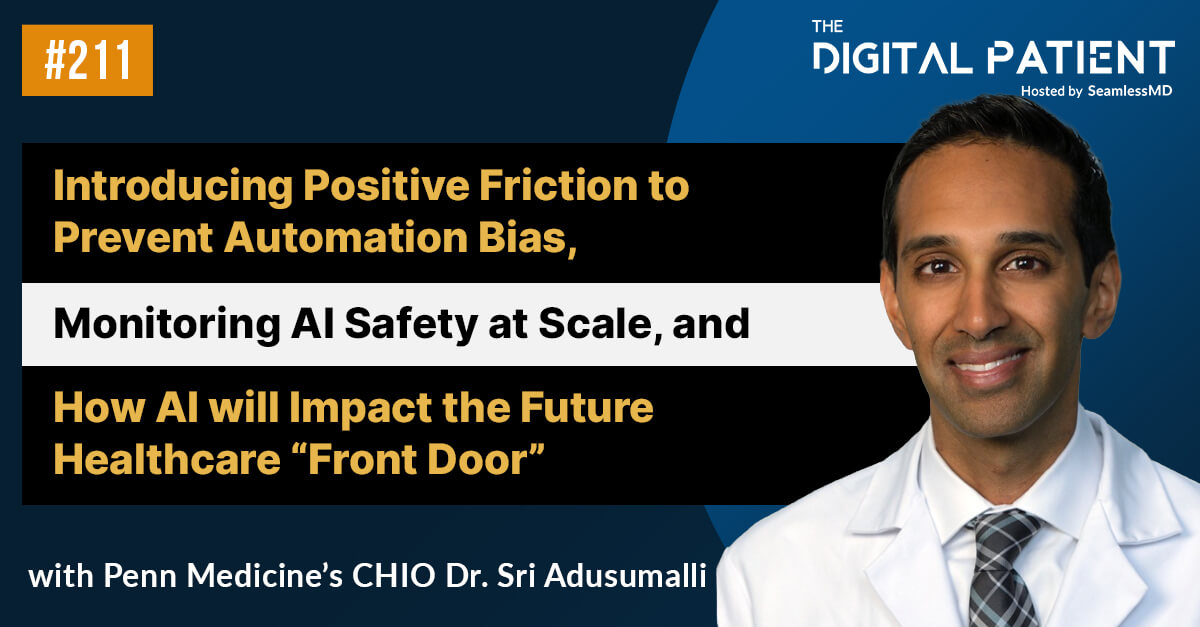
On this episode of The Digital Patient, Dr. Joshua Liu, Co-founder & CEO of SeamlessMD, and colleague, Alan Sardana, chat with Dr. Sri Adusumalli, Vice President and Chief Health Information Officer at Penn Medicine, about "Introducing Positive Friction to Prevent Automation Bias, Monitoring AI Safety at Scale, How AI will Impact the Future Healthcare 'Front Door', and more..." Click the play button to listen or read the show notes below.
Audio:
Guest(s):
- Srinath Adusumalli, MD, Vice President and Chief Health Information Officer at Penn Medicine
- Joshua Liu, MD, Co-founder & CEO at SeamlessMD
Episode 211 - Show Notes:
[00:00:07] Episode preview
[00:05:04] Why Dr. Sri Adusumalli realized in residency that quality and safety improvements often lived or died by how well health IT was designed, especially when discharge summary improvements depended on iterative changes to the technology platform.
[00:06:37] How early work on discharge summary quality revealed the need for “translators” who understand both the clinical problem and the “art of the possible” in technology, enabling change at scale.
[00:07:33] What AI-assisted drafting of hospital courses could change about discharge summaries, including better comprehensiveness and timeliness as care teams become more distributed and handoffs increase.
[00:09:14] Why digital health efforts over-index on tools instead of behavior change, since meaningful behavior change requires motivating action, making the change salient, and making the right action easy through deep collaboration between clinical, operational, and technology teams.
[00:10:00] How Penn Medicine’s Nudge Unit applies behavioral science to EHR alerts, templates, and order sets—and why the next frontier is designing clinician interactions with augmented intelligence tools to reduce risks like automation bias.
[00:12:10] What “positive friction” looks like in AI workflows, including designing draft inbox replies so clinicians must review and edit before sending instead of allowing one-click automation.
[00:13:23] Why the act of writing a note can support deeper “type two thinking,” and how future designs may need to preserve the benefits of reflection without requiring clinicians to manually write everything.
[00:14:23] How health systems can evaluate digital interventions more like drugs by moving beyond implementation and utilization metrics, defining a “mechanism of action,” aligning on expected outcomes, and holding vendors and health systems accountable to those outcomes.
[00:18:26] Why healthcare technology strategy must assume constant change: health systems are “living, breathing organisms,” and new tools should trigger reevaluation of underlying processes instead of automating broken workflows.
[00:21:32] What Sri learned moving from Penn Medicine to CVS Health and back, including how building virtual primary care from scratch taught him a product-oriented mindset for developing, scaling, and articulating value and outcomes.
[00:22:36] How an integrated healthcare model (provider, payer, PBM, retail, pharmacy) sharpened his view on “knitting” together different actors across healthcare to improve the patient experience and outcomes.
[00:24:48] Why taking a consumer-oriented approach means designing technology with deeper empathy, autonomy, and agency for patients—especially across the “bigger picture” of their healthcare experience.
[00:25:38] How chat-based tools like ChatGPT may redefine the “front door” to healthcare, pushing providers to proactively create trusted and safe ways for patients to engage with information and connect to services.
[00:27:37] What it means for clinicians when patients arrive having uploaded their health information into ChatGPT—creating new opportunities to embrace patient-generated insights as the starting point for visits, documentation, and shared interpretation.
[00:32:20] How healthcare risks getting AI wrong by skipping basic quality improvement discipline, and why continuous monitoring and rapid-cycle iteration are essential after deployment to detect safety signals and improve performance at scale.
[00:35:47] Why tool-to-tool interactions create new safety questions, such as generating notes with ambient AI, then summarizing those notes with another AI—and potentially copying summaries back into the legal medical record.
[00:37:04] The non-negotiable priority in the quintuple aim is protecting patient interests—advancing health safely—while also relentlessly simplifying and improving the experience of care teams using technology.
Fast 5 Lightning Round:
- What is your favorite book or book you’ve gifted the most?
The Empire of AI by Karen Hao - If you could instantly master any skill, what would it be?
Storytelling. - Would you rather have Super strength, super speed, or the ability to read people’s minds?
Mind reading. - What is something in healthcare you believe others might find insane?
That we can expand access, improve efficiency, and lower costs—simultaneously. - What is the last movie or TV show you saw?
House of Dynamite… which I thought was excellent.
The Digital Patient has been recognized as Feedspot's #1 Patient Engagement Podcast of 2025. Thank you to our listeners for making this happen!


.png)
