Healthcare News & Views

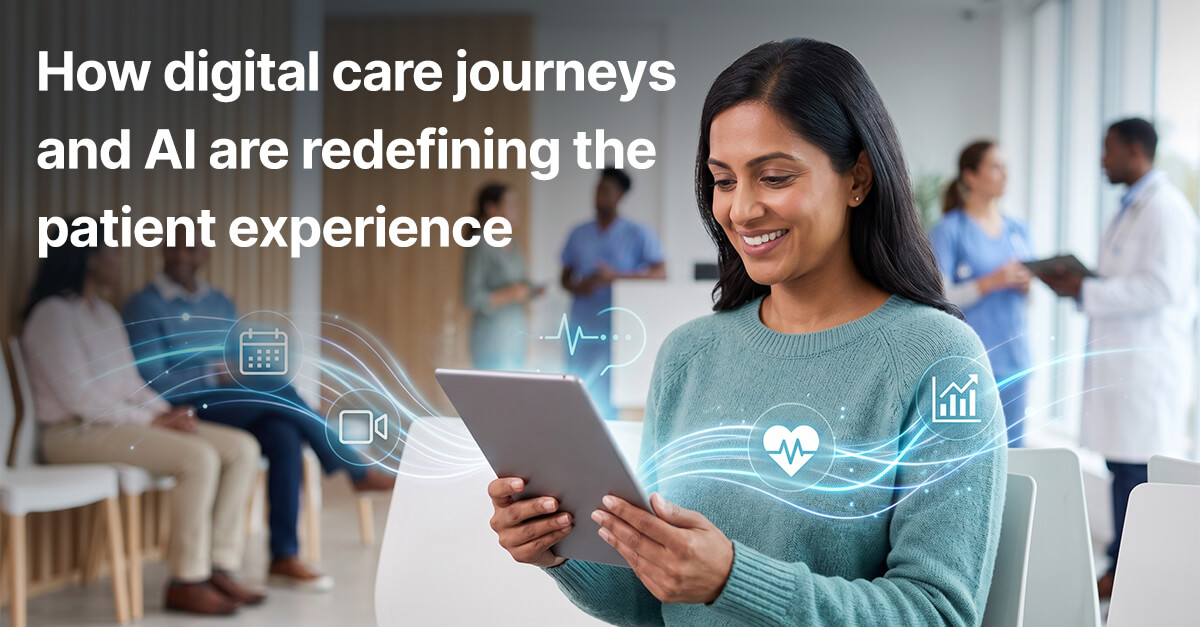
How digital care journeys and AI are redefining the patient experience

May 5, 2026
By
Joshua Liu

Originally published in Canadian Healthcare Technology (March 2026) – Page 22

For decades, the “black hole” of healthcare has existed in the spaces between hospital and clinic visits. We provide world-class care within our walls, but once a patient returns to their community — often hours away — the cord is essentially cut.

Patients are frequently left to navigate complex care protocols with little more than a stack of paper instructions. We founded SeamlessMD in 2012 to bridge this gap by guiding patients across the entire continuum of care.

Our platform acts as a digital GPS for the patient journey, guiding patients through everything from surgery and cancer treatment to chronic disease management.

By leveraging the devices patients already own, hospitals and health authorities can deliver personalized, just-in-time support — including symptom monitoring, reminders, and evidence-based education.

Looking across the Canadian landscape in 2026, the results from leading healthcare organizations are transformative. From the remote geography of Northern Ontario to the province-wide initiatives in Atlantic Canada, digital care journeys are now an essential pillar of patient experience, quality, and safety.

In New Brunswick, Horizon Health Network has demonstrated the power of deploying this technology at a provincial scale. Since 2023, over 5,500 patients have been enrolled in digital journeys that span multiple clinical areas.

The reach of the program covers complex surgeries like cardiac and orthopedic procedures, as well as chronic disease management for heart failure. This province-wide approach has accelerated recovery and allowed for safer transitions from hospital to home.

Horizon Health Network has found SeamlessMD to reduce average length of stay by 42 percent and readmissions by 52 percent in orthopedic surgery, and lower ED visits by 47 percent for cardiac surgery. By reducing stress on the healthcare system, this opens up capacity to care for more patients.

As one Horizon patient put it:

“It makes me feel included. It makes me feel like I matter. It’s like having 24/7 care.”

This sense of continuous support is also becoming a new standard for oncology care on the West Coast. Vancouver Coastal Health’s RESPONSe program is the first in British Columbia to use SeamlessMD for chemotherapy patients. One patient shared how this digital monitoring was a “game-changer” during her battle with cancer.

“It’s night and day,” she said. “Knowing the care team was a click away was reassuring... like having a nurse in your pocket.”

Data from the program’s first year shows that 100 percent of patients would recommend the system to others.

This safety net is equally critical for regions where travel is a barrier. Thunder Bay Regional Health Sciences Centre (TBRHSC) serves a region the size of France, where some partner sites are six hours away.

By implementing digital care journeys across over a dozen clinical areas, TBRHSC proved a motivated care team supported by remote care monitoring could reduce hospital length of stay by 48 percent and ED visits by 31 percent.

In one instance, the platform saved a spine surgery patient’s life by allowing her to flag symptoms of meningitis while in a remote location despite lacking cellular service. The team used SeamlessMD’s Follow Up module to stay in contact with the patient electronically and coordinate a life-saving flight back to the hospital for immediate treatment.

We are seeing this same innovation applied to recovery areas that were previously difficult to track. Muskoka Algonquin Healthcare (MAHC) has scaled the platform to nine clinical areas in just three years. In particular, MAHC launched a stroke digital journey to empower patients and improve self-management between visits.

By tracking biometrics and providing resources for mobility and nutrition, they are ensuring recovery is a guided transition rather than a period of isolation.

While these results are game changing, we recognize that the emergence of AI creates an exciting new opportunity to elevate the patient experience further.

This year SeamlessMD launched “Seamless Answers,” a new conversational AI experience within our existing platform that allows patients to ask questions about their digital care journey in a natural, conversational way.

Our AI provides safe and accurate answers by using Retrieval-Augmented Generation (RAG) to provide responses that align with the hospital or health authority’s already approved healthcare education and protocols for patients.

This alignment with the healthcare team’s own instructions is critical because general-purpose AI (e.g., ChatGPT) lacks context, which can be dangerous in healthcare.

If a patient asks a specific question about their care plan, Seamless Answers ensures the response is based on the approved instructions from the patient’s own care team.

By taking this safe and thoughtful approach to AI, we are ensuring that whether a patient is asking about preparation, recovery, or a treatment plan, the answer is contextually relevant and safe.

Share this post

Subscribe to SeamlessMD Blog

Subscribe Now

How digital care journeys and AI are redefining the patient experience

Posted by:
Joshua Liu
on
May 5, 2026

Originally published in Canadian Healthcare Technology (March 2026) – Page 22

For decades, the “black hole” of healthcare has existed in the spaces between hospital and clinic visits. We provide world-class care within our walls, but once a patient returns to their community — often hours away — the cord is essentially cut.

Patients are frequently left to navigate complex care protocols with little more than a stack of paper instructions. We founded SeamlessMD in 2012 to bridge this gap by guiding patients across the entire continuum of care.

Our platform acts as a digital GPS for the patient journey, guiding patients through everything from surgery and cancer treatment to chronic disease management.

By leveraging the devices patients already own, hospitals and health authorities can deliver personalized, just-in-time support — including symptom monitoring, reminders, and evidence-based education.

Looking across the Canadian landscape in 2026, the results from leading healthcare organizations are transformative. From the remote geography of Northern Ontario to the province-wide initiatives in Atlantic Canada, digital care journeys are now an essential pillar of patient experience, quality, and safety.

In New Brunswick, Horizon Health Network has demonstrated the power of deploying this technology at a provincial scale. Since 2023, over 5,500 patients have been enrolled in digital journeys that span multiple clinical areas.

The reach of the program covers complex surgeries like cardiac and orthopedic procedures, as well as chronic disease management for heart failure. This province-wide approach has accelerated recovery and allowed for safer transitions from hospital to home.

Horizon Health Network has found SeamlessMD to reduce average length of stay by 42 percent and readmissions by 52 percent in orthopedic surgery, and lower ED visits by 47 percent for cardiac surgery. By reducing stress on the healthcare system, this opens up capacity to care for more patients.

As one Horizon patient put it:

“It makes me feel included. It makes me feel like I matter. It’s like having 24/7 care.”

This sense of continuous support is also becoming a new standard for oncology care on the West Coast. Vancouver Coastal Health’s RESPONSe program is the first in British Columbia to use SeamlessMD for chemotherapy patients. One patient shared how this digital monitoring was a “game-changer” during her battle with cancer.

“It’s night and day,” she said. “Knowing the care team was a click away was reassuring... like having a nurse in your pocket.”

Data from the program’s first year shows that 100 percent of patients would recommend the system to others.

This safety net is equally critical for regions where travel is a barrier. Thunder Bay Regional Health Sciences Centre (TBRHSC) serves a region the size of France, where some partner sites are six hours away.

By implementing digital care journeys across over a dozen clinical areas, TBRHSC proved a motivated care team supported by remote care monitoring could reduce hospital length of stay by 48 percent and ED visits by 31 percent.

In one instance, the platform saved a spine surgery patient’s life by allowing her to flag symptoms of meningitis while in a remote location despite lacking cellular service. The team used SeamlessMD’s Follow Up module to stay in contact with the patient electronically and coordinate a life-saving flight back to the hospital for immediate treatment.

We are seeing this same innovation applied to recovery areas that were previously difficult to track. Muskoka Algonquin Healthcare (MAHC) has scaled the platform to nine clinical areas in just three years. In particular, MAHC launched a stroke digital journey to empower patients and improve self-management between visits.

By tracking biometrics and providing resources for mobility and nutrition, they are ensuring recovery is a guided transition rather than a period of isolation.

While these results are game changing, we recognize that the emergence of AI creates an exciting new opportunity to elevate the patient experience further.

This year SeamlessMD launched “Seamless Answers,” a new conversational AI experience within our existing platform that allows patients to ask questions about their digital care journey in a natural, conversational way.

Our AI provides safe and accurate answers by using Retrieval-Augmented Generation (RAG) to provide responses that align with the hospital or health authority’s already approved healthcare education and protocols for patients.

This alignment with the healthcare team’s own instructions is critical because general-purpose AI (e.g., ChatGPT) lacks context, which can be dangerous in healthcare.

If a patient asks a specific question about their care plan, Seamless Answers ensures the response is based on the approved instructions from the patient’s own care team.

By taking this safe and thoughtful approach to AI, we are ensuring that whether a patient is asking about preparation, recovery, or a treatment plan, the answer is contextually relevant and safe.

Recent news from SeamlessMD

TDP 223: ViVE & HIMSS Debrief, A New Father’s View on Digital Health, and How AI Is Exposing Every Crack in the Care Journey
April 9, 2026

TDP 223: ViVE & HIMSS Debrief, A New Father’s View on Digital Health, and How AI Is Exposing Every Crack in the Care Journey

Learn More
The 3rd Annual Seamless Care Awards
April 8, 2026

The 3rd Annual Seamless Care Awards

Learn More
Succeeding with Digital Health even when the Novelty Wears Off: What WRHN's Digital Care Journey Program Shows Four Years In
March 31, 2026

Succeeding with Digital Health even when the Novelty Wears Off: What WRHN's Digital Care Journey Program Shows Four Years In

Learn More