.svg)


September 22, 2026
Subscribe on: RSS | SPOTIFY | APPLE PODCAST | GOOGLE | BREAKER | ANCHOR
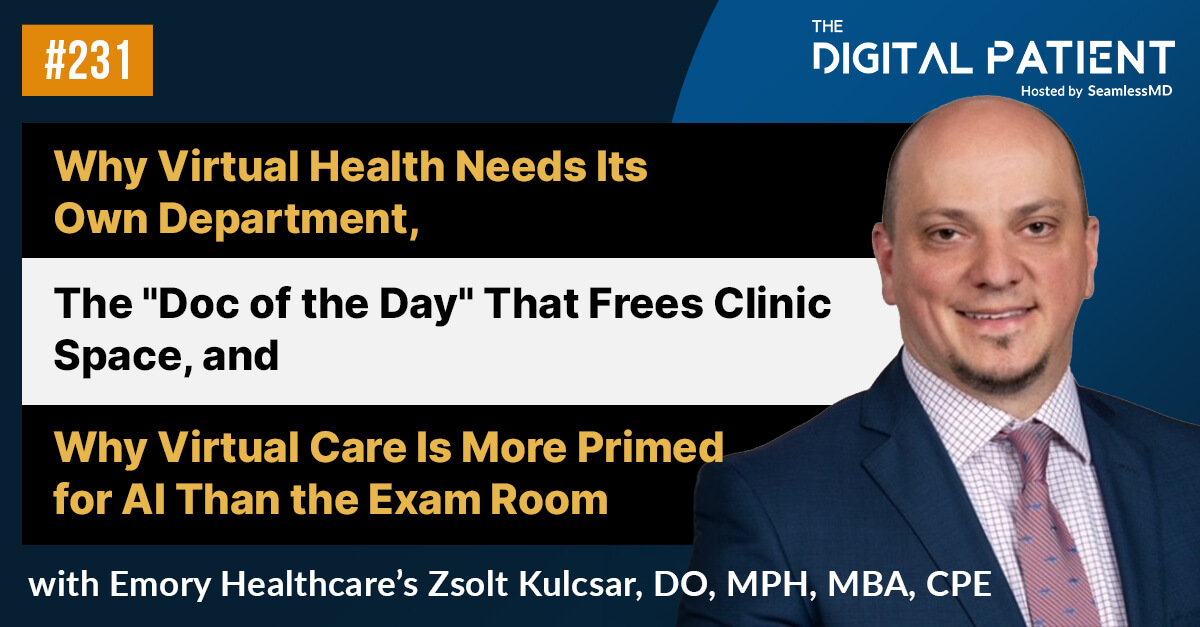
On this episode of The Digital Patient, Dr. Joshua Liu, Co-founder & CEO of SeamlessMD, and colleague, Alan Sardana, chat with Zsolt Kulcsar, DO, MPH, MBA, CPE, Vice President, Virtual Health at Emory Healthcare, about "Why Virtual Health Needs Its Own Department, The "Doc of the Day" That Frees Clinic Space, Why Virtual Care Is More Primed for AI Than the Exam Room, and more..." Click the play button to listen or read the show notes below.
Audio:
Guest(s):
- Zsolt Kulcsar, DO, MPH, MBA, CPE, Vice President, Virtual Health at Emory Healthcare
- Joshua Liu, MD (@joshuapliu), Co-founder & CEO at SeamlessMD
Episode 231 - Show Notes:
[00:00:07] Episode preview
[00:06:40] How a self-described "dreamer" became a systems designer — Dr. Kulcsar describes med school as stifling rote memorization of differentials, then realized in quality roles for ambulatory practices that patient-experience problems needed different tools. The turning point: when you digitize an in-person process, you first discover the in-person experience is often "pretty terrible," so the real opportunity is to start fresh and rebuild from scratch — keeping only what works and leaving the bad pieces behind.
[00:09:50] Why redesigning virtual care has to start with reinventing check-in — Early on, Epic had no seamless self check-in, so medical assistants had to phone every patient before a visit to confirm they had the technology, the app, and the links. Dr. Kulcsar argues self check-in can happen days ahead, with only a brief validation minutes before the visit, so clinical time with the doctor — the most valuable part of the appointment — isn't burned on logistics.
[00:10:58] How Emory's rheumatology team became a high telemedicine utilizer — Close to 30% of the department's visits are telemed, supported by a clean process for engaging patients, checking them in, and capturing intake and medication lists before they're marked ready for the doctor. Medical assistants use different color flags to signal which patients on the schedule will be challenging, so clinicians know in advance where they may need to pick up the phone or switch modalities.
[00:12:35] What has and hasn't changed in telemedicine since 2016 — Writing an early tele-rheumatology paper as a Dartmouth fellow, Dr. Kulcsar used the classic clinic-to-clinic model: a cart in a remote facility with a trained nurse "presenter" performing joint exams. The belief was that training the presenter would raise visit quality. The lesson learned was different — the right answer is picking the right patient at the right stage of disease and meeting them wherever they are (car, office, or home), no presenter required.
[00:14:30] Why most telemedicine peripherals are "a waste of time" — Dr. Kulcsar pushes back on colleagues who insist on integrated devices and remote dermascopes or ultrasounds. His view: get the video modality working, nail the basics like intake, histories, labs, and connection, and only add a peripheral device later if a specific subpopulation truly needs it. "You don't need the entire spaceship with every sensor and radar just to get off the ground… you could figure that out mid-flight."
[00:19:35] Why AI may serve virtual care even better than in-person care — Dr. Kulcsar is bullish that AI is a massive enabler of virtual care, pointing to pre-visit intake summaries and triage that routes patients to the right modality. His example: AI can flag low-risk, low-value referrals (like a positive ANA) into a two-to-three-day e-consult instead of a six-month queue, while reserving in-person, hands-on visits for severe autoimmune disease hitting heart, lungs, and kidneys.
[00:20:53] The everyday AI use cases Dr. Kulcsar sees working today — Ambient scribes, video-based interpreters that feel more personal than a clinic phone line, and tools that read facial expressions and emotion to gauge whether a patient is calm or upset. He's especially focused on remote patient monitoring, where the first pass on a bad reading should be AI-driven triage rather than a nurse spending time chasing patients who simply skipped their medication.
[00:22:55] Why virtual care is more primed for AI than the exam room — Because the camera is on both sides of a video visit, there's visual data naturally available that most office rooms don't capture. Dr. Kulcsar notes a video visit yields far more physical exam data than clinicians assume — wheezing, range of motion, swelling, grip strength — making a level four or even level five visit attainable. The patient's environment is part of the exam too: pets and layered rugs around someone with mobility issues instantly signal a fall risk.
[00:25:34] Why "never-skilling" worries Dr. Kulcsar more than de-skilling — Citing an AI scribe CEO's quote, he argues the bigger danger isn't clinicians losing skills to AI but trainees who were never taught the fundamentals. If you train people on the basics and the limitations of each tool — knowing, for example, that an elbow can't actually have 270 degrees of range of motion — they can take these tools further. He's optimistic AI will produce more efficient, better clinicians.
[00:29:12] Why teachers matter more than students for AI adoption — Dr. Kulcsar argues that exposing the educator generation to new technology is more important than exposing students. If teachers poo-poo the tools and aren't comfortable failing with and learning from them, they can't make students better — so the harder, more important work is getting faculty to embrace and understand the technology's limits.
[00:30:50] What untapped potential Dr. Kulcsar sees in remote patient monitoring — Drawing on running one of Florida's largest RPM shops, he describes a multi-layer triage cascade (interactive voice validation, then nurse, then advanced provider acting on protocol) augmented by AI risk scores for readmission and sepsis. The real promise is holistically gathering all that data to tell the team exactly who to call first — and surfacing patients who get forgotten, including the paying RPM customer who's gone quiet and the stable patient who may no longer need the program.
[00:35:45] How to actually get clinician buy-in for virtual care — Don't try to get everyone on board; engage and educate everyone, but find the few willing experimenters who want to solve a real problem and will stack multiple technologies rather than just work from home. Dr. Kulcsar's "doc of the day" concept has one clinician handle e-visits, e-consults, RPM escalations, and on-demand visits flowing seamlessly into a single optimized day — making the work satisfying and RVU-generating instead of a fragmented, half-utilized telehealth shift.
[00:38:47] How the "doc of the day" model works at Emory — A primary care virtualist medical director designs the day and supports a rotation of 10–11 colleagues who each take a turn. The strategy frees brick-and-mortar space (avoiding new construction as the system hires), lets physicians earn full clinical credit so they can protect research time, and provides stable leadership to "hold the hand" of colleagues rotating through.
[00:41:44] Why virtual health deserves to be its own clinical department — Dr. Kulcsar deliberately pulled RPM out of home health into a standalone department, because data is useless if no one acts on it — a three-to-five-pound weight gain that takes days to address can become a CHF admission. A dedicated department centralizes the tools, protocols, escalation trees, and volume-based routing rules (including staff augmentation when demand spikes) that a traditional brick-and-mortar service line can't support.
[00:45:39] Why virtual programs fail without clear ownership — "If you build it, they won't come." Dr. Kulcsar warns that investing in care companions, e-visits, and e-consults produces no volume if no one owns the program, solicits feedback, and tweaks it — citing how e-consults must be tagged and released to the right departments or providers never find them. He's not a believer in education as the intervention; you need digital tools that actively steer and guide people to what's available.
[00:47:24] How a data-driven approach unlocks virtual care growth — Weekly and monthly dashboards track every product, mapping specific interventions against the growth curve. Dr. Kulcsar has found there's usually one small pivot — like opening an e-consult line beyond primary care to ID and Derm — that suddenly unleashes volume. His counterintuitive advice: start with four or five pathways and optimize them rather than launching twenty, because chasing the next flashy vendor instead of optimizing leaves you with the same unsolved problem.
Fast 5 Lightning Round:
- What is your favorite book or book you’ve gifted the most?
Atomic Habits by James Clear and Who Moved My Cheese? by Spencer Johnson - If you could instantly master any skill, what would it be?
"Some sort of AI-based coding. I'd love to have the brain of a chief technology officer, 'cause I have lots of ideas and I love to build things." - Would you rather have Super strength, super speed, or the ability to read people’s minds?
"Mind reading." - What is something in healthcare you believe others might find insane?
"I think it's insane how many big decisions we make that are life or death with incomplete data... There's so much more we could use from a knowledge perspective, and I think AI will help us get there." - What is the last movie or TV show you saw, and what did you think of it?
"The Sandlot"
The Digital Patient has been recognized as Feedspot's #1 Patient Engagement Podcast of 2025. Thank you to our listeners for making this happen!
.png)
.png)


.png)
