.svg)


.png)
September 10, 2026
Subscribe on: RSS | SPOTIFY | APPLE PODCAST | GOOGLE | BREAKER | ANCHOR
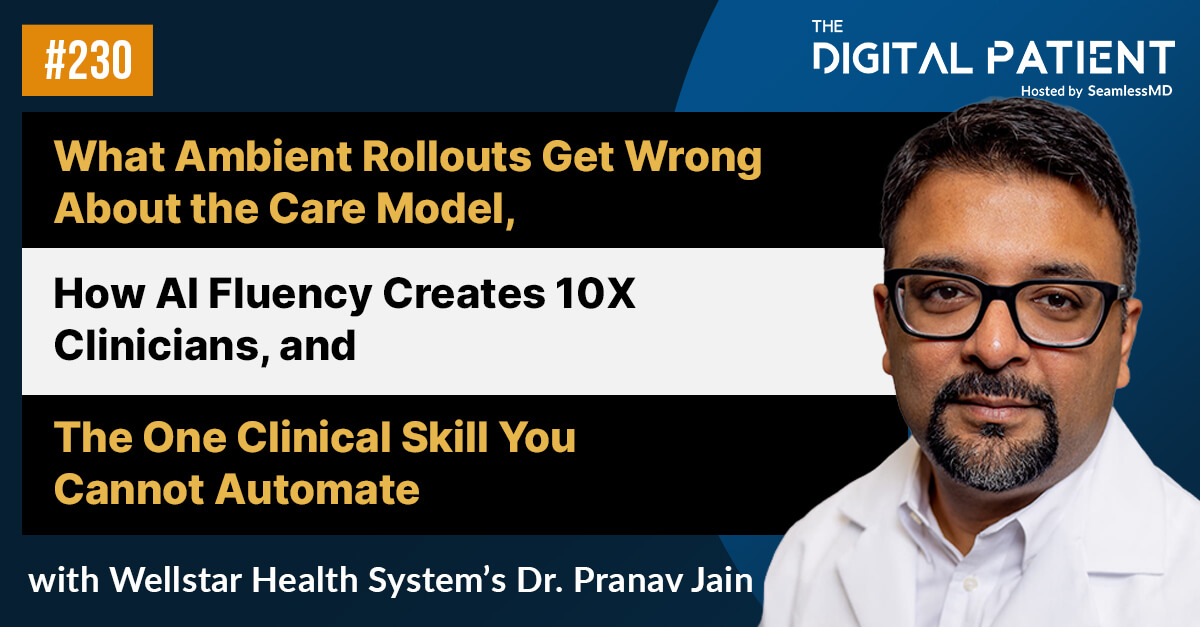
On this episode of The Digital Patient, Dr. Joshua Liu, Co-founder & CEO of SeamlessMD, and colleague, Alan Sardana, chat with Pranav Jain, MD, MBA, Chief Health Information Officer at Wellstar Health System, about "What Ambient Rollouts Get Wrong About the Care Model, How AI Fluency Creates 10X Clinicians, The One Clinical Skill You Cannot Automate, and more..." Click the play button to listen or read the show notes below.
Audio:
Guest(s):
- Pranav Jain, MD, MBA, Chief Health Information Officer at Wellstar Health System
- Joshua Liu, MD (@joshuapliu), Co-founder & CEO at SeamlessMD
Episode 230 - Show Notes:
[00:00:07] Episode preview
[00:05:02] Why Pranav insists on first names — He deliberately asks colleagues to drop "Dr. Jain," explaining that health systems have spent years building safety culture, and a simple honorific can create a power gradient that silences good ideas. "Just because somebody who has a title has a thought doesn't make it more important."
[00:06:44] How a rural hospital's Meaningful Use struggle pulled Pranav into informatics — Working in a resource-constrained rural health system, he watched technology teams build order sets that had no clinical flow and were effectively unusable. He raised his hand to help redesign the system, spent six to eight months rebuilding the entire stack with clinician input, and found that once the conversation shifted from technology to their actual work, his peers eagerly engaged.
[00:10:56] Why AI fluency will be a 10X multiplier for clinicians — Pranav points to the explosion of ambient documentation tools like Abridge and Dax as proof: clinicians who've adopted them report going home on time and leaving weekends chart-free. But adoption follows a bell curve and requires genuine personal effort to unlearn deeply ingrained habits. "The belief that this is gonna actually improve my life... and then reaping the benefits."
[00:13:26] What deploying AI at scale actually demands — Beyond the technology itself, Pranav says the real challenge is fundamentally redesigning the care model. Using ambient listening as an example, he walks through the layers involved: patient consent, room setup, clinician prompting habits, draft review, and note style preferences. The key question operators must start asking: every time a task is repeatable and manual, can it be intelligently automated?
[00:16:26] How ambient documentation is changing the nursing care model in unexpected ways — After one health system implemented ambient on the inpatient nursing side, patients began reacting in real time to clinical observations being verbalized aloud — observations they'd never heard before. Pranav affirms this is the care model changing for the better, but cautions that nurse time per patient room increased 15–20%, and organizations need patience to see the full value emerge.
[00:17:56] Why health systems that resist AI adoption face long-term consequences — Pranav sees three groups forming: organizations building the new care model, fast followers, and the resistant. He warns the last group will face real problems over time in recruitment and survival. "The life cycle of change is dramatic. Oh my God, it's dramatic now."
[00:22:25] How frontline engagement in health IT has fundamentally shifted — Where it once took significant effort to get clinicians involved in technology design, Pranav now sees genuine demand. Training programs have embedded digital tools so deeply that new graduates simply don't know another way to work, and broader societal shifts in digital behavior have reinforced it. "The more frontline team members who are delivering care get engaged and involved and wanna make a difference, the better the system gets."
[00:25:25] How Pranav introduces AI tools to trainees — He strongly advocates exposing students and residents to AI today, but with intentional guardrails: select curious individuals who raise their hands, help them understand pitfalls, and build a graduated access model based on demonstrated competency. He cautions against giving everyone access at once. "That can be potentially dangerous." The goal is a thoughtful pipeline with a graduating scale of access and responsibility.
[00:27:55] Why competency assessments lag clinical practice by years — Josh raises the analogy of driving exams that still ban rearview cameras even as every driver uses them daily. Pranav agrees the dynamic applies directly to medicine — he credits ABIM for moving toward a more open-book long-form exam, but estimates that regulatory and licensing bodies are generally five to eight years behind current clinical practice.
[00:29:25] How Pranav advises clinicians who want to get into informatics — He has four to five of these conversations monthly and tailors guidance to each person's goals. For those who want to observe, he recommends attending system-level committees. For those who want to build, he points them toward free Epic virtual certification programs, then embeds them in real active problems. The core traits he looks for: curiosity and a deep sense of humility.
[00:32:55] Why the Peter Principle is a leadership principle every manager should internalize — Pranav applies it to healthcare succession: promote based on whether someone has the skills for the next role, not because they excel in their current one. He used it personally, recognizing a gap in financial literacy while managing multiple teams and pursuing an MBA to close it. He advises leaders to have direct, kind conversations about specific skill gaps — and to watch for hesitation, because putting a high performer in the wrong role can destroy their confidence and harm the team.
[00:37:55] How AI is changing what individual contribution looks like — Pranav sees teams starting to rethink day-to-day work: automated meeting notes have changed how decisions get made asynchronously, and one team is building an agent to replace a manual lab testing process using synthetic data. His prediction: teams will shrink, and curiosity and core problem-solving methodology will matter more than certifications. "I would rather you try and fail than just say, 'Well, I don't know. Get a vendor to do it for me.'"
[00:41:25] What contextual AI means for the future of precision medicine — Pranav describes merging real-time EHR data — including unlocked unstructured data — with evidence tools like Open Evidence to deliver next-best-action recommendations at the bedside. He calls it a "cognitive friend" that helps physicians surface what they might have missed, not a replacement. He sees this compressing the seven-year guideline-to-practice adoption cycle down to two to three years, improving patient outcomes far beyond academic institutions.
[00:46:55] Why executive leaders must actively create space for frontline experimentation — Despite consumer AI tools being widely accessible, Pranav acknowledges that policy pressures and reimbursement headwinds leave healthcare operators little headspace to experiment on the job. He challenges executive leadership to identify passionate frontline innovators and give them structured time and pathways to shape how new technology gets built — not expect it to happen on people's own time.
[00:48:25] What Pranav believes should never be automated — The sacred bond between patient and caregiver. Empathy cannot be technologically replicated. The two to five minutes spent simply recognizing a patient's fear, or a family's distress at 2 a.m., is irreplaceable. "You can have synthetic voice talking in place of someone, but that's not the same as empathy and really understanding what a patient's needs are in that moment."
Fast 4 Lightning Round:
- What is your favorite book or book you’ve gifted the most?
Radical Candor by Kim Scott and The Five Dysfunctions of a Team by Paul Lencioni - If you could instantly master any skill, what would it be?
"Communication. Effective communication. How to talk to people in a way that is truly closest to how they wanna receive the information." - Would you rather have Super strength, super speed, or the ability to read people’s minds?
"That's easy. Always read people's minds. Knowledge is power. It's the ultimate form of power." - What is something in healthcare you believe others might find insane?
"We still use faxes. The average health system probably receives over 100,000 faxes a month. And we use CDs, by the way. We still burn CDs. Even though there are not enough CD burners left on Earth to read those CDs."
The Digital Patient has been recognized as Feedspot's #1 Patient Engagement Podcast of 2025. Thank you to our listeners for making this happen!
.png)
.png)


.png)
