Digital Patient Podcast

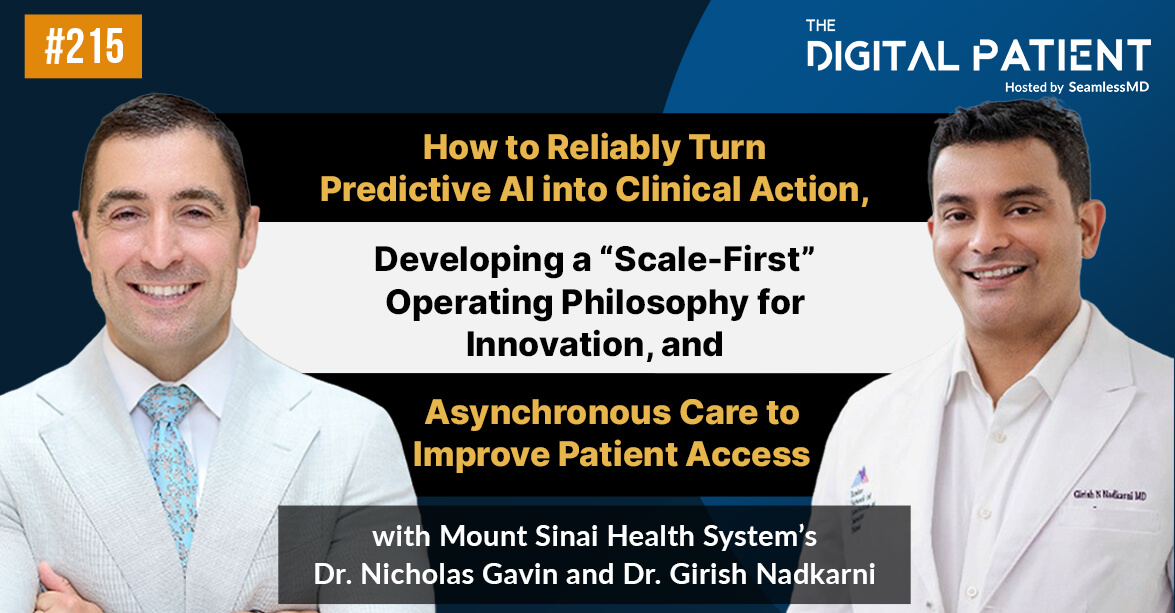
TDP 215: Mount Sinai’s Drs. Gavin & Nadkarni: How to Reliably Turn Predictive AI into Clinical Action, Developing a “Scale-First” Operating Philosophy for Innovation, and Asynchronous Care to Improve Patient Access

January 22, 2026
By
Seamless

Subscribe on: RSS | SPOTIFY | APPLE PODCAST | GOOGLE | BREAKER | ANCHOR

On this episode of The Digital Patient, Dr. Joshua Liu, Co-founder & CEO of SeamlessMD, and colleague, Alan Sardana, chat with Dr. Nicholas Gavin, Chief Clinical Innovation Officer and Associate Chief Medical Information Officer for Digital Health at Mount Sinai, and Dr. Girish Nadkarni, Chairman of AI and Human Health at Mount Sinai, about "How to Reliably Turn Predictive AI into Clinical Action, Developing a 'Scale-First' Operating Philosophy for Innovation, Asynchronous Care to Improve Patient Access, and more..." Click the play button to listen or read the show notes below.

Audio:

Guest(s):

  • Nicholas (Nick) Gavin, MD, MBA, MS, Chief Clinical Innovation Officer and Associate Chief Medical Information Officer for Digital Health at Mount Sinai
  • Girish Nadkarni, MD, MPH, Chairman of AI and Human Health at Mount Sinai
  • Joshua Liu, MD, Co-founder & CEO at SeamlessMD

Episode 215 - Show Notes:

[00:00:07] Episode preview

[00:06:59] How Drs. Gavin and Nadkarni balance each other out; Dr. Nadkarni admits Dr. Gavin pushed him to start every build with the “why” and the problem to solve, with technology as the outer layer.

[00:11:31] Why closing the gap between research and operations requires starting with “why,” using patient experience, quality, and operational outcomes to decide what gets built and measured.

[00:14:24] Why Dr. Gavin rejects small pilots: even limited deployments carry real risk, illustrated by a symptom-check demo that routed patients to a competitor due to insufficient QA.

[00:19:28] How predictive models become actionable when paired with guideline-based next steps, and why aligning outputs to what clinicians already use drives adoption.

[00:22:47] What explainability, interpretability, and transparency mean in practice—and why interpretability is essential for direct clinical decision support but less critical for administrative optimization.

[00:28:56] Why asynchronous message-only care can reduce acute volume and expand access, using structured intake and a single comprehensive provider response to avoid unnecessary visits.

[00:35:30] Mount Sinai’s stance on automation in asynchronous care: workflows can be highly automated, but “human in the loop” remains for at least 5%... for now.

[00:36:30] How Mount Sinai governs AI today with risk-based review and continuous monitoring—and why scaling that oversight will require stratification, automation, and orchestration as adoption grows.

[00:41:56] The “small” workflow shift Dr. Gavin expects to become transformative: integrating wearable data with EHR data and surfacing information (not raw data) to support bedside conversations and recovery.

[00:43:36] How Dr. Nadkarni predicts the next five years will be defined by redesigning workflows for human–AI collaboration—AI-first in some steps, human-first in others, and measurable outcomes guiding it all.

[00:45:27] Why culture and change management determine whether workflow redesign sticks, and why “stuffing AI into the existing workflow” can make workflows worse rather than better.

Fast 5 Lightning Round:

  1. What is your favorite book or book you’ve gifted the most?
    Dr. Gavin: Setting the Table by Daniel Meyer
    Dr. Nadkarni: The Culture Code by Daniel Coyle
  2. If you could instantly master any skill, what would it be?
    Dr. Gavin: Playing the piano.
    Dr. Nadkarni: Actively listening... to understand.
  3. Would you rather have Super strength, super speed, or the ability to read people’s minds?
    Dr. Gavin: Speed.
    Dr. Nadkarni: None of the above... more like Batman.
  4. What is something in healthcare you believe others might find insane?
    Dr. Gavin: The lack of aligned incentives.
    Dr. Nadkarni: Fax machines.
  5. What is the last movie or TV show you saw?
    Dr. Gavin: Homeland. Love the character development.
    Dr. Nadkarni: F1 - One of the best sports movies of all time!

The Digital Patient has been recognized as Feedspot's #1 Patient Engagement Podcast of 2025. Thank you to our listeners for making this happen!

TDP 215: Mount Sinai’s Drs. Gavin & Nadkarni: How to Reliably Turn Predictive AI into Clinical Action, Developing a “Scale-First” Operating Philosophy for Innovation, and Asynchronous Care to Improve Patient Access

Posted by:
Seamless
on
January 22, 2026

Subscribe on: RSS | SPOTIFY | APPLE PODCAST | GOOGLE | BREAKER | ANCHOR

On this episode of The Digital Patient, Dr. Joshua Liu, Co-founder & CEO of SeamlessMD, and colleague, Alan Sardana, chat with Dr. Nicholas Gavin, Chief Clinical Innovation Officer and Associate Chief Medical Information Officer for Digital Health at Mount Sinai, and Dr. Girish Nadkarni, Chairman of AI and Human Health at Mount Sinai, about "How to Reliably Turn Predictive AI into Clinical Action, Developing a 'Scale-First' Operating Philosophy for Innovation, Asynchronous Care to Improve Patient Access, and more..." Click the play button to listen or read the show notes below.

Audio:

Guest(s):

  • Nicholas (Nick) Gavin, MD, MBA, MS, Chief Clinical Innovation Officer and Associate Chief Medical Information Officer for Digital Health at Mount Sinai
  • Girish Nadkarni, MD, MPH, Chairman of AI and Human Health at Mount Sinai
  • Joshua Liu, MD, Co-founder & CEO at SeamlessMD

Episode 215 - Show Notes:

[00:00:07] Episode preview

[00:06:59] How Drs. Gavin and Nadkarni balance each other out; Dr. Nadkarni admits Dr. Gavin pushed him to start every build with the “why” and the problem to solve, with technology as the outer layer.

[00:11:31] Why closing the gap between research and operations requires starting with “why,” using patient experience, quality, and operational outcomes to decide what gets built and measured.

[00:14:24] Why Dr. Gavin rejects small pilots: even limited deployments carry real risk, illustrated by a symptom-check demo that routed patients to a competitor due to insufficient QA.

[00:19:28] How predictive models become actionable when paired with guideline-based next steps, and why aligning outputs to what clinicians already use drives adoption.

[00:22:47] What explainability, interpretability, and transparency mean in practice—and why interpretability is essential for direct clinical decision support but less critical for administrative optimization.

[00:28:56] Why asynchronous message-only care can reduce acute volume and expand access, using structured intake and a single comprehensive provider response to avoid unnecessary visits.

[00:35:30] Mount Sinai’s stance on automation in asynchronous care: workflows can be highly automated, but “human in the loop” remains for at least 5%... for now.

[00:36:30] How Mount Sinai governs AI today with risk-based review and continuous monitoring—and why scaling that oversight will require stratification, automation, and orchestration as adoption grows.

[00:41:56] The “small” workflow shift Dr. Gavin expects to become transformative: integrating wearable data with EHR data and surfacing information (not raw data) to support bedside conversations and recovery.

[00:43:36] How Dr. Nadkarni predicts the next five years will be defined by redesigning workflows for human–AI collaboration—AI-first in some steps, human-first in others, and measurable outcomes guiding it all.

[00:45:27] Why culture and change management determine whether workflow redesign sticks, and why “stuffing AI into the existing workflow” can make workflows worse rather than better.

Fast 5 Lightning Round:

  1. What is your favorite book or book you’ve gifted the most?
    Dr. Gavin: Setting the Table by Daniel Meyer
    Dr. Nadkarni: The Culture Code by Daniel Coyle
  2. If you could instantly master any skill, what would it be?
    Dr. Gavin: Playing the piano.
    Dr. Nadkarni: Actively listening... to understand.
  3. Would you rather have Super strength, super speed, or the ability to read people’s minds?
    Dr. Gavin: Speed.
    Dr. Nadkarni: None of the above... more like Batman.
  4. What is something in healthcare you believe others might find insane?
    Dr. Gavin: The lack of aligned incentives.
    Dr. Nadkarni: Fax machines.
  5. What is the last movie or TV show you saw?
    Dr. Gavin: Homeland. Love the character development.
    Dr. Nadkarni: F1 - One of the best sports movies of all time!

The Digital Patient has been recognized as Feedspot's #1 Patient Engagement Podcast of 2025. Thank you to our listeners for making this happen!

Recent news from SeamlessMD

6 Strategies to Navigate the CMS TEAM Model Using Digital Care Journeys
January 20, 2026

6 Strategies to Navigate the CMS TEAM Model Using Digital Care Journeys

Learn More
TDP 214: LifePoint Health’s Dr. Ryan Mackey: Operationalizing 5 AI Scribe Vendors Across a System, How to Enforce Quality Across a Fragmented, Multi-EHR Health System, and Expanding AI Beyond Physicians
January 20, 2026

TDP 214: LifePoint Health’s Dr. Ryan Mackey: Operationalizing 5 AI Scribe Vendors Across a System, How to Enforce Quality Across a Fragmented, Multi-EHR Health System, and Expanding AI Beyond Physicians

Learn More
Innovation Spotlight Series: How Southlake Health Is Advancing Patient-Centered Orthopedic Care Through Digital Innovation
January 15, 2026

Innovation Spotlight Series: How Southlake Health Is Advancing Patient-Centered Orthopedic Care Through Digital Innovation

Learn More