Digital Patient Podcast

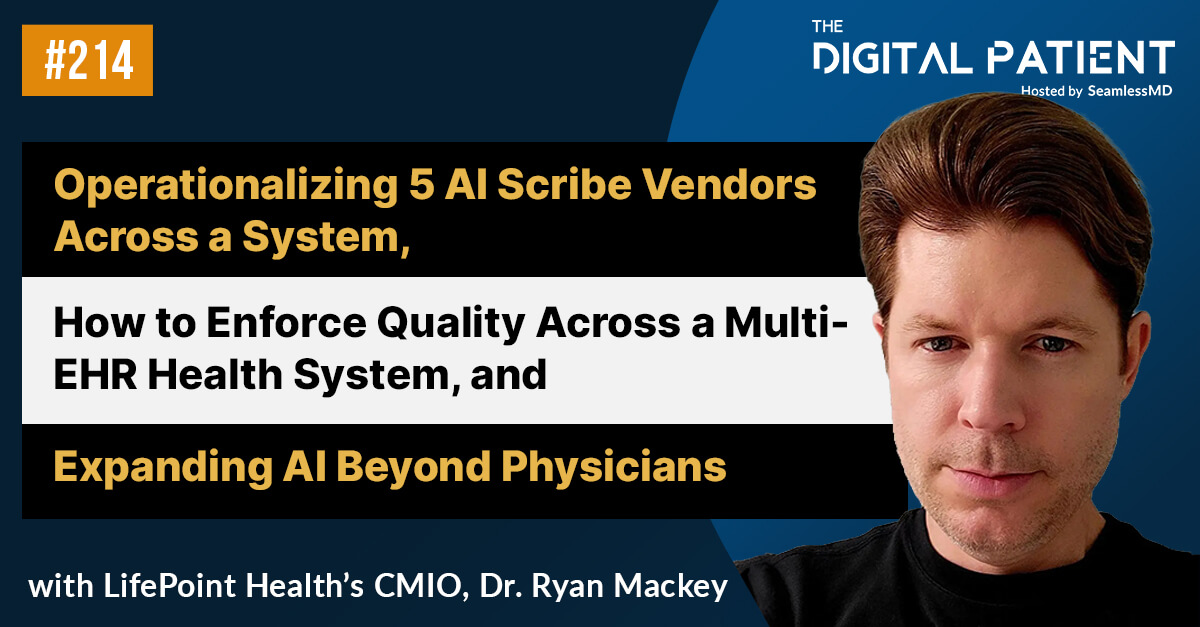
TDP 214: LifePoint Health’s Dr. Ryan Mackey: Operationalizing 5 AI Scribe Vendors Across a System, How to Enforce Quality Across a Fragmented, Multi-EHR Health System, and Expanding AI Beyond Physicians

January 20, 2026
By
Seamless

Subscribe on: RSS | SPOTIFY | APPLE PODCAST | GOOGLE | BREAKER | ANCHOR

On this episode of The Digital Patient, Dr. Joshua Liu, Co-founder & CEO of SeamlessMD, and colleague, Alan Sardana, chat with Dr. Ryan Mackey, CMIO at LifePoint Health, about "Operationalizing 5 AI Scribe Vendors Across a System, How to Enforce Quality Across a Fragmented, Multi-EHR Health System, Expanding AI Beyond Physicians, and more..." Click the play button to listen or read the show notes below.

Audio:

Guest(s):

  • Ryan Mackey, MD, Chief Medical Information Officer at LifePoint Health
  • Joshua Liu, MD, Co-founder & CEO at SeamlessMD

Episode 214 - Show Notes:

[00:00:07] Episode preview

[00:05:09] Why Dr. Mackey says this is an especially timely moment to talk about healthcare technology given how fast the landscape is changing.

[00:06:03] How LifePoint’s scale (60 acute hospitals, nearly 100 post-acute facilities across 35 states) drives real complexity—and why he still pushes for standardization where possible.

[00:09:32] What consolidation looks like in a multi-EHR world, including supporting eight acute EHR instances and using vendor end-of-life timelines (e.g., “sunset… at the end of 2028”) to force hard decisions.

[00:11:40] How he approaches change by listening first, then moving quickly with vetted options—while staying close to vendors even before buying so the organization can track what’s evolving and choose best-fit tools when needed.

[00:18:32] What Dr. Mackey sees as the make-or-break factor in ambient AI: deep integration is “foundational,” non-integrated workflows often fail in real usage, and multi-EHR realities can require multiple scribe vendors as roadmaps expand beyond notes into coding/billing, referrals, and pre-charting.

[00:24:39] Why Epic’s direction—especially with Microsoft alignment—could reshape the vendor ecosystem, with some health systems holding steady while watching pricing, rollout sequence, and early adopter results.

[00:24:39] How he expects AI adoption to broaden beyond physicians to nursing, PT, social work, and other roles—because the goal is to “give AI to more end users, not less.”

[00:28:55] What breaks in cross-EHR clinician workflows when providers move between outpatient and inpatient systems—and why he pushes vendors to build for the “50 plus percent that aren’t epic.”

[00:31:51] How an early career moment (“just here to shake hands”) shaped his leadership model: he wants to be hands-on and act as an “interpreter” between clinical reality and technical execution.

[00:35:06] The leadership trap he avoids (“being an empty coat”) and the alternative: being a trusted, practical clinical resource providers can reach directly—especially through partnerships and transitions across facilities.

[00:37:09] How he defines innovation that actually scales: start with incubation, prove value, expand from one site to many, refine with metrics, and balance buying vendor solutions with building capabilities inside markets—including evaluating AI beyond documentation in areas like supply chain.

[00:41:05] Why some AI ROI stories are inherently market-dependent, and why the best outcomes often require cross-department alignment (OR, plant ops, pharmacy) plus stronger quality enablement—like specialty reporting for anesthesia and surgical quality that drives best-practice consistency.

[00:44:56] What he wants clinicians to do to thrive with AI: understand current limits, adopt foundational tools early, build champions, and keep AI clinically grounded—paired with his optimism that near-term progress depends on tools “playing nicely together.”

Fast 5 Lightning Round:

  1. What is your favorite book or book you’ve gifted the most?
    Radical Acceptance by Tara Brach
  2. If you could instantly master any skill, what would it be?
    The ability to create a portal to teleport anywhere instantly... or time management.
  3. Would you rather have Super strength, super speed, or the ability to read people’s minds?
    Mind reading.
  4. What is something in healthcare you believe others might find insane?
    That you can have a fragmented tech stack market by market and still create and maintain a standard level of quality market by market.
  5. What is the last movie or TV show you saw?
    Curb Your Enthusiasm or a True Crime podcast

The Digital Patient has been recognized as Feedspot's #1 Patient Engagement Podcast of 2025. Thank you to our listeners for making this happen!

Share this post

Subscribe to SeamlessMD Blog

Subscribe Now

TDP 214: LifePoint Health’s Dr. Ryan Mackey: Operationalizing 5 AI Scribe Vendors Across a System, How to Enforce Quality Across a Fragmented, Multi-EHR Health System, and Expanding AI Beyond Physicians

Posted by:
Seamless
on
January 20, 2026

Subscribe on: RSS | SPOTIFY | APPLE PODCAST | GOOGLE | BREAKER | ANCHOR

On this episode of The Digital Patient, Dr. Joshua Liu, Co-founder & CEO of SeamlessMD, and colleague, Alan Sardana, chat with Dr. Ryan Mackey, CMIO at LifePoint Health, about "Operationalizing 5 AI Scribe Vendors Across a System, How to Enforce Quality Across a Fragmented, Multi-EHR Health System, Expanding AI Beyond Physicians, and more..." Click the play button to listen or read the show notes below.

Audio:

Guest(s):

  • Ryan Mackey, MD, Chief Medical Information Officer at LifePoint Health
  • Joshua Liu, MD, Co-founder & CEO at SeamlessMD

Episode 214 - Show Notes:

[00:00:07] Episode preview

[00:05:09] Why Dr. Mackey says this is an especially timely moment to talk about healthcare technology given how fast the landscape is changing.

[00:06:03] How LifePoint’s scale (60 acute hospitals, nearly 100 post-acute facilities across 35 states) drives real complexity—and why he still pushes for standardization where possible.

[00:09:32] What consolidation looks like in a multi-EHR world, including supporting eight acute EHR instances and using vendor end-of-life timelines (e.g., “sunset… at the end of 2028”) to force hard decisions.

[00:11:40] How he approaches change by listening first, then moving quickly with vetted options—while staying close to vendors even before buying so the organization can track what’s evolving and choose best-fit tools when needed.

[00:18:32] What Dr. Mackey sees as the make-or-break factor in ambient AI: deep integration is “foundational,” non-integrated workflows often fail in real usage, and multi-EHR realities can require multiple scribe vendors as roadmaps expand beyond notes into coding/billing, referrals, and pre-charting.

[00:24:39] Why Epic’s direction—especially with Microsoft alignment—could reshape the vendor ecosystem, with some health systems holding steady while watching pricing, rollout sequence, and early adopter results.

[00:24:39] How he expects AI adoption to broaden beyond physicians to nursing, PT, social work, and other roles—because the goal is to “give AI to more end users, not less.”

[00:28:55] What breaks in cross-EHR clinician workflows when providers move between outpatient and inpatient systems—and why he pushes vendors to build for the “50 plus percent that aren’t epic.”

[00:31:51] How an early career moment (“just here to shake hands”) shaped his leadership model: he wants to be hands-on and act as an “interpreter” between clinical reality and technical execution.

[00:35:06] The leadership trap he avoids (“being an empty coat”) and the alternative: being a trusted, practical clinical resource providers can reach directly—especially through partnerships and transitions across facilities.

[00:37:09] How he defines innovation that actually scales: start with incubation, prove value, expand from one site to many, refine with metrics, and balance buying vendor solutions with building capabilities inside markets—including evaluating AI beyond documentation in areas like supply chain.

[00:41:05] Why some AI ROI stories are inherently market-dependent, and why the best outcomes often require cross-department alignment (OR, plant ops, pharmacy) plus stronger quality enablement—like specialty reporting for anesthesia and surgical quality that drives best-practice consistency.

[00:44:56] What he wants clinicians to do to thrive with AI: understand current limits, adopt foundational tools early, build champions, and keep AI clinically grounded—paired with his optimism that near-term progress depends on tools “playing nicely together.”

Fast 5 Lightning Round:

  1. What is your favorite book or book you’ve gifted the most?
    Radical Acceptance by Tara Brach
  2. If you could instantly master any skill, what would it be?
    The ability to create a portal to teleport anywhere instantly... or time management.
  3. Would you rather have Super strength, super speed, or the ability to read people’s minds?
    Mind reading.
  4. What is something in healthcare you believe others might find insane?
    That you can have a fragmented tech stack market by market and still create and maintain a standard level of quality market by market.
  5. What is the last movie or TV show you saw?
    Curb Your Enthusiasm or a True Crime podcast

The Digital Patient has been recognized as Feedspot's #1 Patient Engagement Podcast of 2025. Thank you to our listeners for making this happen!

Recent news from SeamlessMD

6 Strategies to Navigate the CMS TEAM Model Using Digital Care Journeys
January 20, 2026

6 Strategies to Navigate the CMS TEAM Model Using Digital Care Journeys

Learn More
Innovation Spotlight Series: How Southlake Health Is Advancing Patient-Centered Orthopedic Care Through Digital Innovation
January 15, 2026

Innovation Spotlight Series: How Southlake Health Is Advancing Patient-Centered Orthopedic Care Through Digital Innovation

Learn More
TDP 213: John Muir Health’s CMIO Dr. Priti Patel: Phenotypes of Clinician AI Adopters, Demonstrating ROI Without Stifling Innovation, and How to Make Governance an Enabler, Not a Brake
January 15, 2026

TDP 213: John Muir Health’s CMIO Dr. Priti Patel: Phenotypes of Clinician AI Adopters, Demonstrating ROI Without Stifling Innovation, and How to Make Governance an Enabler, Not a Brake

Learn More