Digital Patient Podcast

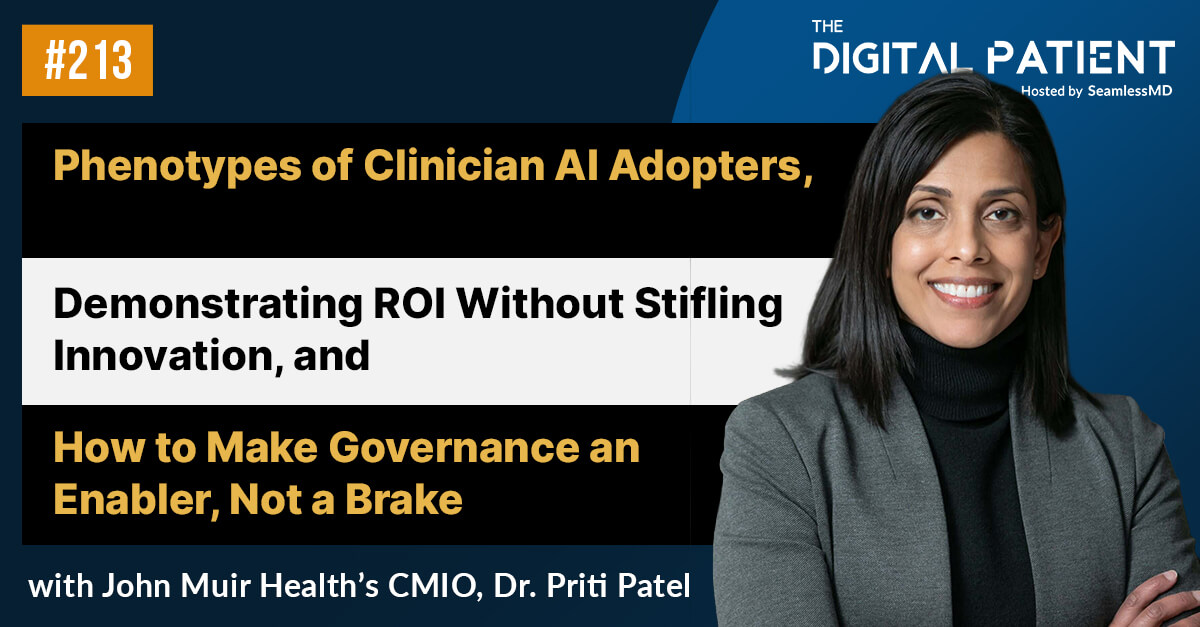
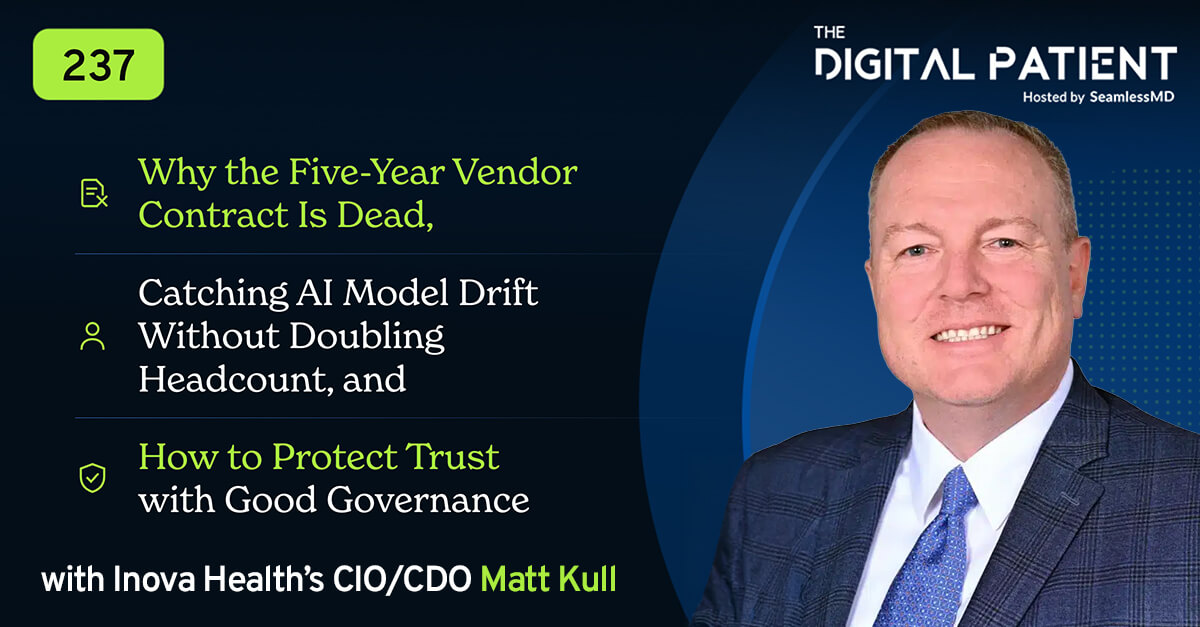
TDP 213: John Muir Health’s CMIO Dr. Priti Patel: Phenotypes of Clinician AI Adopters, Demonstrating ROI Without Stifling Innovation, and How to Make Governance an Enabler, Not a Brake

January 15, 2026
By
Seamless

Subscribe on: RSS | SPOTIFY | APPLE PODCAST | GOOGLE | BREAKER | ANCHOR

On this episode of The Digital Patient, Dr. Joshua Liu, Co-founder & CEO of SeamlessMD, and colleague, Alan Sardana, chat with Dr. Priti Patel, CMIO at John Muir Health, about "Phenotypes of Clinician AI Adopters, Demonstrating ROI Without Stifling Innovation, How to Make Governance an Enabler, Not a Brake, and more..." Click the play button to listen or read the show notes below.

Audio:

Guest(s):

  • Priti Patel, MD, Chief Medical Information Officer at John Muir Health
  • Joshua Liu, MD, Co-founder & CEO at SeamlessMD

Episode 213 - Show Notes:

[00:00:07] Episode preview

[00:05:27] Why scaling AI isn’t “plug and play,” requiring ongoing people, process, and cross-functional feedback because the technology changes month to month

[00:06:43] How driving adoption requires different strategies for early adopters, “finished product” skeptics, and clinicians comfortable in existing workflows

[00:07:34] What AI literacy demands beyond tip sheets, including explaining how models reach conclusions and where closer review and editing are needed

[00:08:16] Why demonstrating ROI is becoming essential as AI remains expensive and finance teams need “demonstrable return on investment” to scale further

[00:09:49] How generative AI pushed John Muir toward formal governance, including an AI governance council and an evaluation committee to review tools over time

[00:11:40] The expectation-setting that helps adoption: AI “is not perfect,” improves over time, and user feedback is part of making it better

[00:13:10] What made ambient scribing feel like an obvious system-wide bet early on: a hands-on scenario where the output “worked amazingly” and matched real primary-care documentation needs

[00:14:52] How Epic integration accelerated ambient adoption, and why some clinicians resisted until workflow friction (like copy-paste) was removed

[00:15:40] Why certain clinicians still didn’t adopt ambient scribing, including highly efficient Dragon users, specialty copy-forward workflows, and already-fast documenters

[00:16:24] How new ambient capabilities broadened value, including pulling forward prior-visit context for returning patients and generating personalized post-visit instructions

[00:18:15] What builds clinician confidence in chart summarization tools: references that show exactly where data is pulled from in the medical record

[00:19:35] The human impact behind retention metrics, with clinicians describing less fatigue, more “mental clarity,” and “restoring the joy in practice,” including late-career physicians extending practice

[00:27:04] How John Muir decides when to lead versus fast-follow by prioritizing clear problems, confident solutions, and high-impact use cases like summarization and conversational AI for access and experience

[00:29:20] Why an internal champion determines whether early AI succeeds, because without one “even the most perfect technology… is not going to go anywhere”

[00:34:14] How a margin-improvement push revealed organization-wide data gaps, prompting a data literacy program (executives first, then directors/managers) plus ongoing reporting office hours

[00:37:19] The operating system that turns dashboards into behavior change: a daily management system linking KPIs, actions, and measurement through continuous process improvement

Fast 5 Lightning Round:

  1. What is your favorite book or book you’ve gifted the most?
    What Every BODY is Saying by Joe Navarro and Marvin Karlins
  2. If you could instantly master any skill, what would it be?
    Languages.
  3. Would you rather have Super strength, super speed, or the ability to read people’s minds?
    Super speed.
  4. What is something in healthcare you believe others might find insane?
    "I like (most) regulations in Health IT because they push us to innovate"
  5. What is the last movie or TV show you saw?
    Bugonia, which was great!

The Digital Patient has been recognized as Feedspot's #1 Patient Engagement Podcast of 2025. Thank you to our listeners for making this happen!
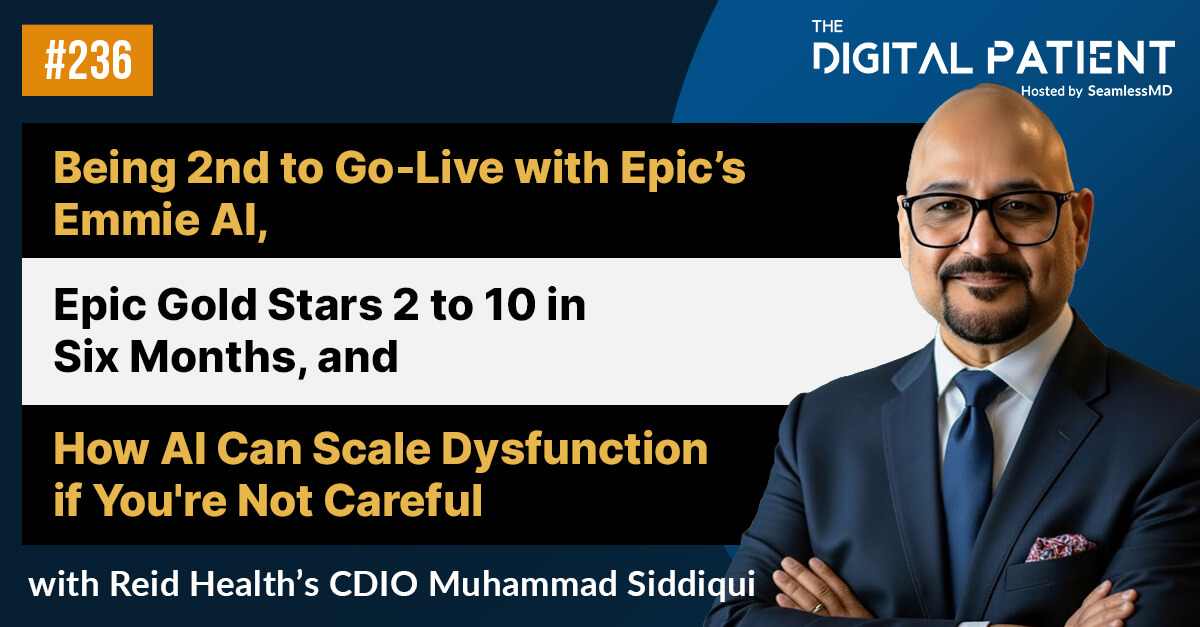
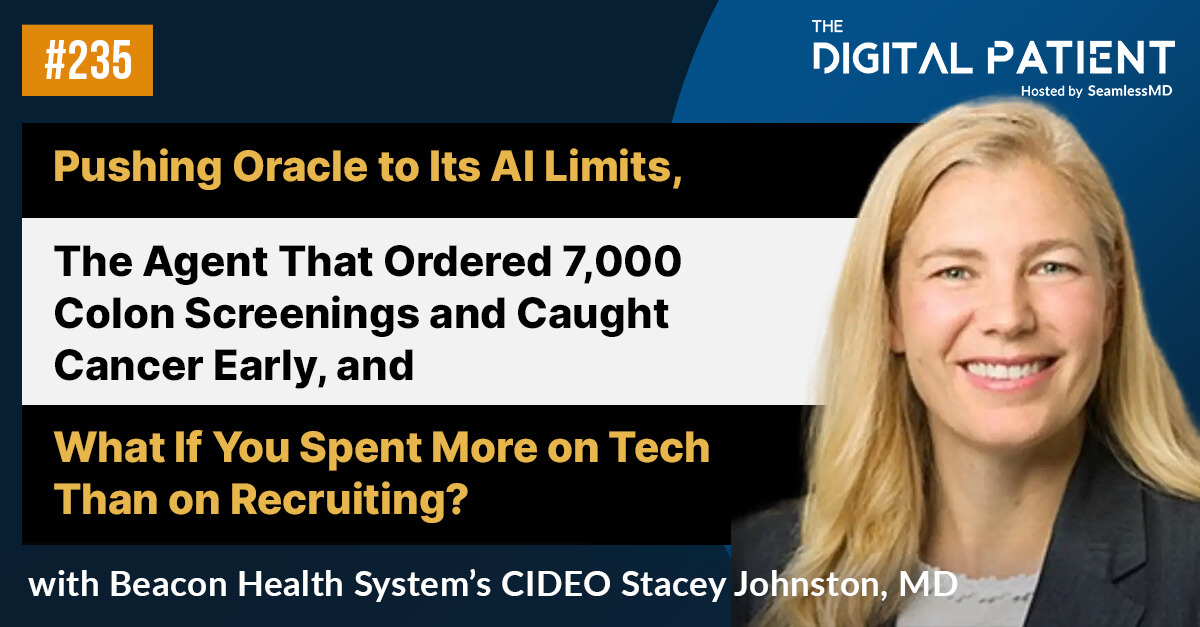
TDP 213: John Muir Health’s CMIO Dr. Priti Patel: Phenotypes of Clinician AI Adopters, Demonstrating ROI Without Stifling Innovation, and How to Make Governance an Enabler, Not a Brake

Posted by:
Seamless
on
January 15, 2026

Subscribe on: RSS | SPOTIFY | APPLE PODCAST | GOOGLE | BREAKER | ANCHOR

On this episode of The Digital Patient, Dr. Joshua Liu, Co-founder & CEO of SeamlessMD, and colleague, Alan Sardana, chat with Dr. Priti Patel, CMIO at John Muir Health, about "Phenotypes of Clinician AI Adopters, Demonstrating ROI Without Stifling Innovation, How to Make Governance an Enabler, Not a Brake, and more..." Click the play button to listen or read the show notes below.

Audio:

Guest(s):

  • Priti Patel, MD, Chief Medical Information Officer at John Muir Health
  • Joshua Liu, MD, Co-founder & CEO at SeamlessMD

Episode 213 - Show Notes:

[00:00:07] Episode preview

[00:05:27] Why scaling AI isn’t “plug and play,” requiring ongoing people, process, and cross-functional feedback because the technology changes month to month

[00:06:43] How driving adoption requires different strategies for early adopters, “finished product” skeptics, and clinicians comfortable in existing workflows

[00:07:34] What AI literacy demands beyond tip sheets, including explaining how models reach conclusions and where closer review and editing are needed

[00:08:16] Why demonstrating ROI is becoming essential as AI remains expensive and finance teams need “demonstrable return on investment” to scale further

[00:09:49] How generative AI pushed John Muir toward formal governance, including an AI governance council and an evaluation committee to review tools over time

[00:11:40] The expectation-setting that helps adoption: AI “is not perfect,” improves over time, and user feedback is part of making it better

[00:13:10] What made ambient scribing feel like an obvious system-wide bet early on: a hands-on scenario where the output “worked amazingly” and matched real primary-care documentation needs

[00:14:52] How Epic integration accelerated ambient adoption, and why some clinicians resisted until workflow friction (like copy-paste) was removed

[00:15:40] Why certain clinicians still didn’t adopt ambient scribing, including highly efficient Dragon users, specialty copy-forward workflows, and already-fast documenters

[00:16:24] How new ambient capabilities broadened value, including pulling forward prior-visit context for returning patients and generating personalized post-visit instructions

[00:18:15] What builds clinician confidence in chart summarization tools: references that show exactly where data is pulled from in the medical record

[00:19:35] The human impact behind retention metrics, with clinicians describing less fatigue, more “mental clarity,” and “restoring the joy in practice,” including late-career physicians extending practice

[00:27:04] How John Muir decides when to lead versus fast-follow by prioritizing clear problems, confident solutions, and high-impact use cases like summarization and conversational AI for access and experience

[00:29:20] Why an internal champion determines whether early AI succeeds, because without one “even the most perfect technology… is not going to go anywhere”

[00:34:14] How a margin-improvement push revealed organization-wide data gaps, prompting a data literacy program (executives first, then directors/managers) plus ongoing reporting office hours

[00:37:19] The operating system that turns dashboards into behavior change: a daily management system linking KPIs, actions, and measurement through continuous process improvement

Fast 5 Lightning Round:

  1. What is your favorite book or book you’ve gifted the most?
    What Every BODY is Saying by Joe Navarro and Marvin Karlins
  2. If you could instantly master any skill, what would it be?
    Languages.
  3. Would you rather have Super strength, super speed, or the ability to read people’s minds?
    Super speed.
  4. What is something in healthcare you believe others might find insane?
    "I like (most) regulations in Health IT because they push us to innovate"
  5. What is the last movie or TV show you saw?
    Bugonia, which was great!

The Digital Patient has been recognized as Feedspot's #1 Patient Engagement Podcast of 2025. Thank you to our listeners for making this happen!

Recent news from SeamlessMD

TDP 212: UMMS’ Emily Jacobsen: Why Trust is the Real Operating System for Clinical Transformation, Using Leadership Rounding as an Informatics Superpower, and How to Avoid Pilots That Never Scale
January 13, 2026

TDP 212: UMMS’ Emily Jacobsen: Why Trust is the Real Operating System for Clinical Transformation, Using Leadership Rounding as an Informatics Superpower, and How to Avoid Pilots That Never Scale

Learn More
How UAB Transformed the Bariatric Surgery Journey with Digital Care Pathways
January 12, 2026

How UAB Transformed the Bariatric Surgery Journey with Digital Care Pathways

Learn More
TDP 211: Penn Medicine’s CHIO Dr. Sri Adusumalli: Introducing Positive Friction to Prevent Automation Bias, Monitoring AI Safety at Scale, and How AI will Impact the Future Healthcare “Front Door”
January 8, 2026

TDP 211: Penn Medicine’s CHIO Dr. Sri Adusumalli: Introducing Positive Friction to Prevent Automation Bias, Monitoring AI Safety at Scale, and How AI will Impact the Future Healthcare “Front Door”

Learn More