Digital Patient Podcast

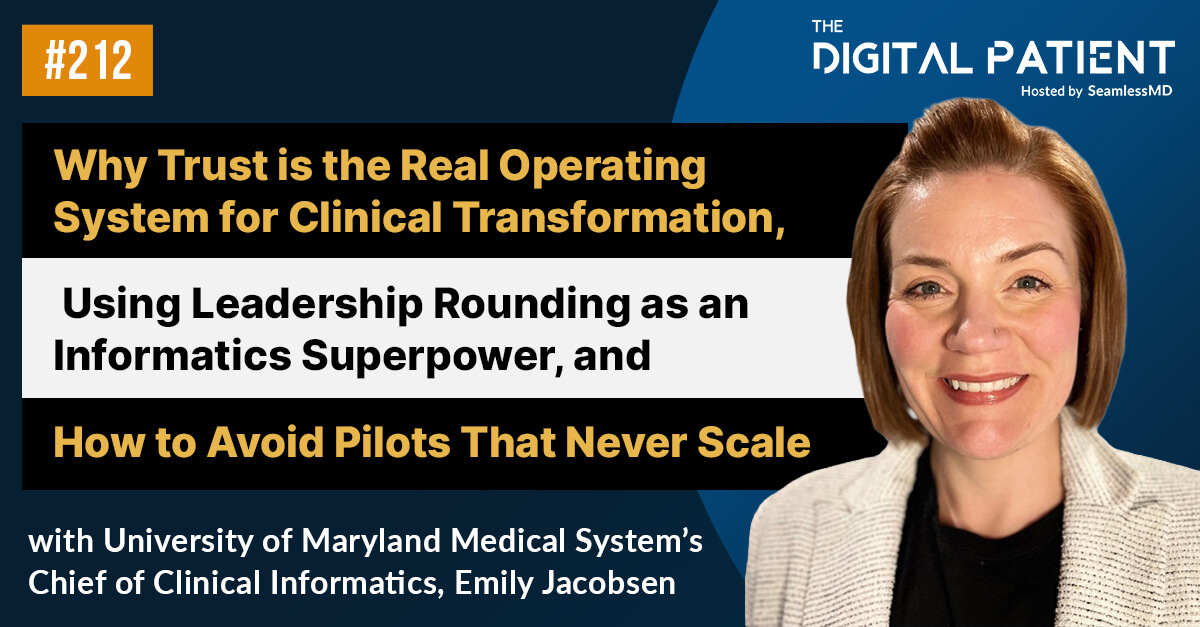
TDP 212: UMMS’ Emily Jacobsen: Why Trust is the Real Operating System for Clinical Transformation, Using Leadership Rounding as an Informatics Superpower, and How to Avoid Pilots That Never Scale

January 13, 2026
By
Seamless

Subscribe on: RSS | SPOTIFY | APPLE PODCAST | GOOGLE | BREAKER | ANCHOR

On this episode of The Digital Patient, Dr. Joshua Liu, Co-founder & CEO of SeamlessMD, and colleague, Alan Sardana, chat with Emily Jacobsen, VP, Clinical Systems, Chief of Clinical Informatics at University of Maryland Medical System, about "Why Trust is the Real Operating System for Clinical Transformation, Using Leadership Rounding as an Informatics Superpower, How to Avoid Pilots That Never Scale, and more..." Click the play button to listen or read the show notes below.

Audio:

Guest(s):

  • Emily Jacobsen, Vice President, Clinical Systems, and Chief of Clinical Informatics at University of Maryland Medical System
  • Joshua Liu, MD, Co-founder & CEO at SeamlessMD

Episode 212 - Show Notes:

[00:00:07] Episode preview

[00:05:22] Why digital transformation fails when it’s treated as “just technology,” and succeeds when leaders build trust, align incentives, and clearly define the “why” for users.

[00:06:48] How the AI wave is increasing urgent inbound requests—while “plug it in, it works” pitches (including “it’s just FHIR”) still require real due diligence, governance, and IT partnership from the start.

[00:10:29] What creates tension between vendor innovation and health system readiness, since healthcare can’t “fail fast” when patient safety, clinician burnout, and real care risk are on the line.

[00:13:08] How strong vendors earn trust by clearly identifying the problem, staying focused on a niche, asking questions, listening, and being honest about product limitations.

[00:16:24] What “pilot-to-scale” looks like across a diverse 13-hospital system: buy vs build vs expand, matching pilots to the problem and the user group, and choosing sites that are genuinely excited to adopt.

[00:20:29] How VP-level rounding across departments surfaces real frontline challenges beyond IT, linking leadership visibility to system goals like improving safety statewide.

[00:23:02] Why informal rounding works when it creates psychological safety and closes the loop—down to fixing basic blockers like a printer that “hasn't worked for months.”

[00:26:34] How UMMS approached SlicerDicer “democratizing data” by starting where adoption was strongest (e.g., Rev Cycle, Pharmacy), setting governance, and using repeated retraining to expand trust and use cases.

[00:29:31] What drives real adoption is diagnosing “why” through observation and deep listening, recognizing that workflow and culture differences across hospitals change how tools land.

[00:32:30] The reality of health system IT work: “99%… customer service,” where teams must show value, understand workflows, and “sell the why” to earn attention and sustained use.

[00:34:27] How a healthcare-law lens strengthens informatics leadership: improving governance, ethics, vendor negotiation, risk assessment, and patient-centered thinking about data use.

[00:38:43] What maintains clinical trust during rapid model deployment: early clinician engagement, rigorous validation, transparency about limitations, and no corner-cutting in testing and review.

[00:41:38] How responsible AI use depends on governance plus continuous feedback and monitoring—spot checks, easy “thumbs up/down” reporting, and AI literacy because “there is no way to monitor all of it.”

[00:45:47] Why predictive models only matter when they’re actionable inside real workflows—and why monitoring usage and learning from “who uses it well” is as important as the implementation itself.

[00:51:12] How IT success comes from being a trusted partner and thought leader—while keeping patients human and central as EHRs and AI expand.

Fast 5 Lightning Round:

  1. What is your favorite book or book you’ve gifted the most?
    More Than Enough: Claiming Space for Who You Are (No Matter What They Say) by Elaine Welteroth
  2. If you could instantly master any skill, what would it be?
    Throwing pottery.
  3. Would you rather have Super strength, super speed, or the ability to read people’s minds?
    Mind reading.
  4. What is something in healthcare you believe others might find insane?
    "Sometimes the simplest solutions are the best."
  5. What is the last movie or TV show you saw?
    The Beast in Me

The Digital Patient has been recognized as Feedspot's #1 Patient Engagement Podcast of 2025. Thank you to our listeners for making this happen!
TDP 212: UMMS’ Emily Jacobsen: Why Trust is the Real Operating System for Clinical Transformation, Using Leadership Rounding as an Informatics Superpower, and How to Avoid Pilots That Never Scale

Posted by:
Seamless
on
January 13, 2026

Subscribe on: RSS | SPOTIFY | APPLE PODCAST | GOOGLE | BREAKER | ANCHOR

On this episode of The Digital Patient, Dr. Joshua Liu, Co-founder & CEO of SeamlessMD, and colleague, Alan Sardana, chat with Emily Jacobsen, VP, Clinical Systems, Chief of Clinical Informatics at University of Maryland Medical System, about "Why Trust is the Real Operating System for Clinical Transformation, Using Leadership Rounding as an Informatics Superpower, How to Avoid Pilots That Never Scale, and more..." Click the play button to listen or read the show notes below.

Audio:

Guest(s):

  • Emily Jacobsen, Vice President, Clinical Systems, and Chief of Clinical Informatics at University of Maryland Medical System
  • Joshua Liu, MD, Co-founder & CEO at SeamlessMD

Episode 212 - Show Notes:

[00:00:07] Episode preview

[00:05:22] Why digital transformation fails when it’s treated as “just technology,” and succeeds when leaders build trust, align incentives, and clearly define the “why” for users.

[00:06:48] How the AI wave is increasing urgent inbound requests—while “plug it in, it works” pitches (including “it’s just FHIR”) still require real due diligence, governance, and IT partnership from the start.

[00:10:29] What creates tension between vendor innovation and health system readiness, since healthcare can’t “fail fast” when patient safety, clinician burnout, and real care risk are on the line.

[00:13:08] How strong vendors earn trust by clearly identifying the problem, staying focused on a niche, asking questions, listening, and being honest about product limitations.

[00:16:24] What “pilot-to-scale” looks like across a diverse 13-hospital system: buy vs build vs expand, matching pilots to the problem and the user group, and choosing sites that are genuinely excited to adopt.

[00:20:29] How VP-level rounding across departments surfaces real frontline challenges beyond IT, linking leadership visibility to system goals like improving safety statewide.

[00:23:02] Why informal rounding works when it creates psychological safety and closes the loop—down to fixing basic blockers like a printer that “hasn't worked for months.”

[00:26:34] How UMMS approached SlicerDicer “democratizing data” by starting where adoption was strongest (e.g., Rev Cycle, Pharmacy), setting governance, and using repeated retraining to expand trust and use cases.

[00:29:31] What drives real adoption is diagnosing “why” through observation and deep listening, recognizing that workflow and culture differences across hospitals change how tools land.

[00:32:30] The reality of health system IT work: “99%… customer service,” where teams must show value, understand workflows, and “sell the why” to earn attention and sustained use.

[00:34:27] How a healthcare-law lens strengthens informatics leadership: improving governance, ethics, vendor negotiation, risk assessment, and patient-centered thinking about data use.

[00:38:43] What maintains clinical trust during rapid model deployment: early clinician engagement, rigorous validation, transparency about limitations, and no corner-cutting in testing and review.

[00:41:38] How responsible AI use depends on governance plus continuous feedback and monitoring—spot checks, easy “thumbs up/down” reporting, and AI literacy because “there is no way to monitor all of it.”

[00:45:47] Why predictive models only matter when they’re actionable inside real workflows—and why monitoring usage and learning from “who uses it well” is as important as the implementation itself.

[00:51:12] How IT success comes from being a trusted partner and thought leader—while keeping patients human and central as EHRs and AI expand.

Fast 5 Lightning Round:

  1. What is your favorite book or book you’ve gifted the most?
    More Than Enough: Claiming Space for Who You Are (No Matter What They Say) by Elaine Welteroth
  2. If you could instantly master any skill, what would it be?
    Throwing pottery.
  3. Would you rather have Super strength, super speed, or the ability to read people’s minds?
    Mind reading.
  4. What is something in healthcare you believe others might find insane?
    "Sometimes the simplest solutions are the best."
  5. What is the last movie or TV show you saw?
    The Beast in Me

The Digital Patient has been recognized as Feedspot's #1 Patient Engagement Podcast of 2025. Thank you to our listeners for making this happen!

Recent news from SeamlessMD

How UAB Transformed the Bariatric Surgery Journey with Digital Care Pathways
January 12, 2026

How UAB Transformed the Bariatric Surgery Journey with Digital Care Pathways

Learn More
TDP 211: Penn Medicine’s CHIO Dr. Sri Adusumalli: Introducing Positive Friction to Prevent Automation Bias, Monitoring AI Safety at Scale, and How AI will Impact the Future Healthcare “Front Door”
January 8, 2026

TDP 211: Penn Medicine’s CHIO Dr. Sri Adusumalli: Introducing Positive Friction to Prevent Automation Bias, Monitoring AI Safety at Scale, and How AI will Impact the Future Healthcare “Front Door”

Learn More
TDP 210: UT Health’s ACMIO Dr. Tomi Kolade: The Unconventional Metric he uses to Measure Value for Informatics Tools, Reducing Knowledge Gaps to Improve EHR Usage, and Why AI Adoption is a People Problem
January 6, 2026

TDP 210: UT Health’s ACMIO Dr. Tomi Kolade: The Unconventional Metric he uses to Measure Value for Informatics Tools, Reducing Knowledge Gaps to Improve EHR Usage, and Why AI Adoption is a People Problem

Learn More