.svg)


September 22, 2026
Subscribe on: RSS | SPOTIFY | APPLE PODCAST | GOOGLE | BREAKER | ANCHOR
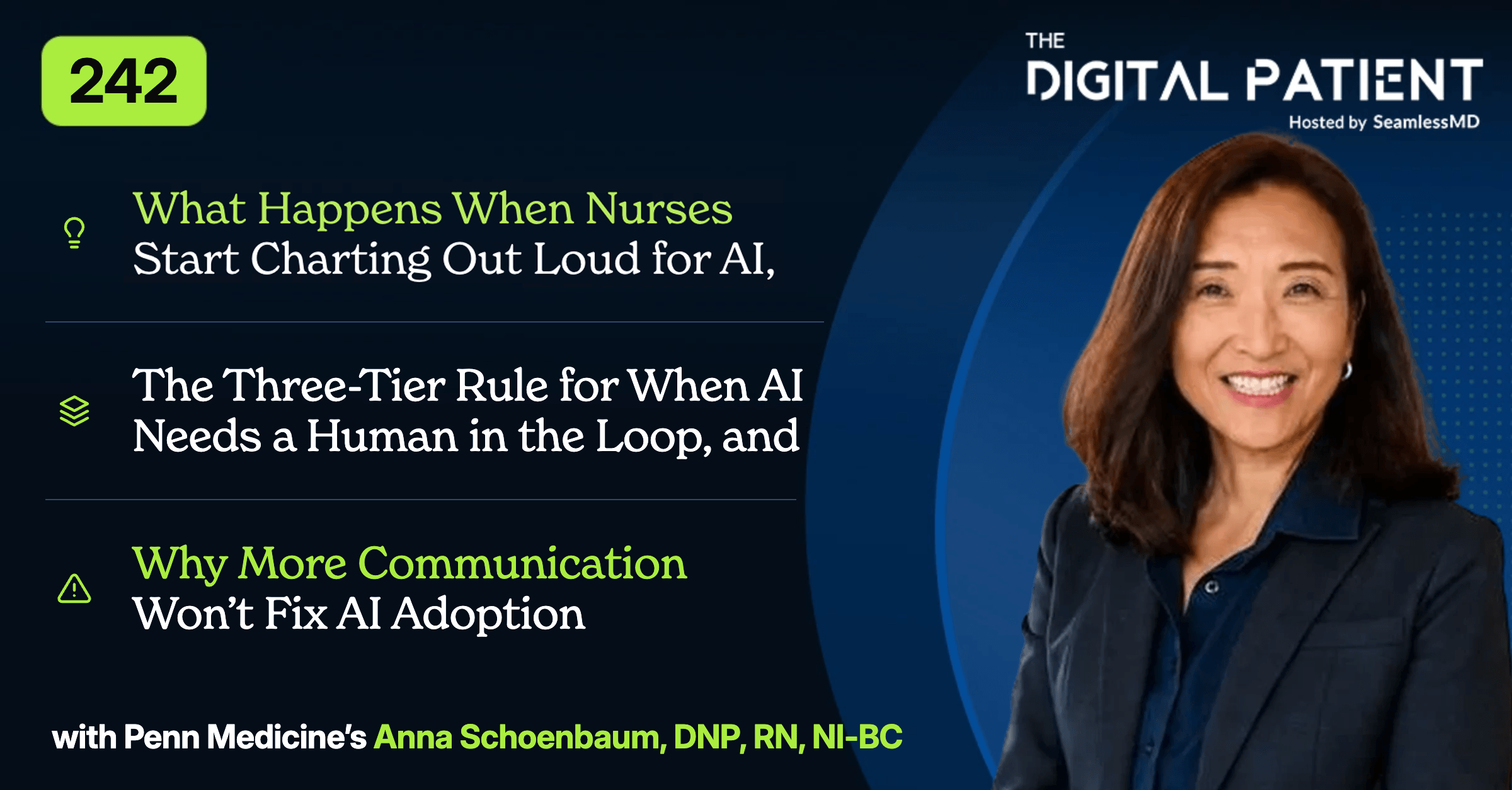
On this episode of The Digital Patient, Joshua Liu, MD, Co-founder & CEO of SeamlessMD, and colleague, Alan Sardana, chat with Anna Schoenbaum, DNP, RN, NI‑BC, Vice President and Chief Digital Applications Officer at Penn Medicine, about "What Happens When Nurses Start Charting Out Loud for AI, The 3-Tier Rule for When AI Needs a Human in the Loop, Why More Communication Won't Fix AI Adoption, and more..." Click the play button to listen or read the show notes below.
Audio:
Guest(s):
- Anna Schoenbaum, DNP, RN, NI-BC, Vice President and Chief Digital Applications Officer at Penn Medicine
- Joshua Liu, MD (@joshuapliu), Co-founder & CEO at SeamlessMD
Episode 242 - Show Notes:
[00:00:07] Episode preview
00:05:49] How two moments as a nurse pointed Ms. Schoenbaum toward health IT — as a pediatric critical care nurse, she watched parents of frequent ICU patients arrive with notebooks and folders full of information, answering the same questions for every provider, case manager, and discharge planner. Later, as a nurse manager, she sat on a committee redesigning the paper card decks nurses used to transcribe orders so that data could flow into them electronically. Both showed her technology could solve the problem of repetitive information "as long as the data flowed from one to another." What has stayed with her is holistic care: connecting the dots from ambulatory to inpatient, inpatient to home care, and home care back to ambulatory.
[00:08:23] Why she chose a role that brings clinical science, informatics, and leadership together — early in her career she was a nurse manager in Chapel Hill managing a tertiary care center and found she loved leadership and management. Wherever her path took her, she wanted to be part of leadership in a strong organization, and a role combining "the best of all worlds, which is clinical science, informatics, and just leadership" let her bring it all together.
[00:09:30] How people and AI work in concert to transform care — technology, including AI, doesn't transform healthcare on its own; leadership and frontline users decide how it gets adopted, where it fits, and what problem it solves. AI can raise the baseline and expose friction that has been normalized. She quotes a health system leader from a recent call on ambient nursing workflows: the goal is to "make sure that the technology works for us, that we're not working for the technology." People need to be involved in product design and strategy, validating accuracy to build trust, and monitoring once a tool is live.
[00:11:44] What Penn Medicine has learned from ambient documentation for nurses — the Penn Sparks program covers anyone who uses ambient intelligence, and is now live for more than 550 inpatient users and about 80 nurses doing ambulatory nurse triage daily. On the inpatient side it is changing practice toward "care out loud," with spoken information flowing into the flow sheet, which is harder than on the provider side because data points must map to flow sheet fields. Flow sheet latency has decreased by 50%, putting data in front of caregivers in real time and potentially meaning less time in the EHR, more time with patients, and leaving on time rather than documenting after the fact.
[00:14:10] Why triage nurses won't give up ambient despite a clunky workflow — on the ambulatory side, the nurse triage workflow still isn't seamless and Penn is fine-tuning it with the vendor. Even so, nurses say they wouldn't want to go back, because of the reduction in cognitive burden and the ability to listen to the patient one-on-one instead of documenting while they listen.
[00:15:22] How "care out loud" is changing the conversation with patients — in the adult med-surg rollout, patients now hear and understand what is being documented, which can spark new discussions. She suspects geriatric populations may see an easier transition, recalling how nurses always talked to her dad when he was in the hospital. As a pediatric critical care nurse, narrating care was already a custom: "Bobby Sue, I'm gonna be doing this. I'm gonna be listening to your heart." She sees the change moving in the right direction, with patients engaging more in their care.
[00:19:27] What every clinical leader should understand before approving an AI tool — start with the problem, not the product; the clinical problem might be solved with AI, with existing tools, or with education and training on current functionality. The problem should be clearly defined and measurable with an understood endpoint. She then pressure tests three areas: workflow, so the tool is seamless and gets adopted; accountability, meaning someone owns the product and its outcomes and users validate that output is accurate, fair, and non-biased before go-live and again after upgrades or code changes; and monitoring, so performance doesn't drift as new data is added or the model changes.
[00:22:23] How Penn Medicine approaches AI literacy for frontline clinicians — frontline staff first need a general understanding of what AI is, supported by online computer-based training that is highly encouraged but not mandatory. Clinicians using a tool embedded in their workflow, such as an end-of-shift summarization report, need to understand the output and how it was generated. Tools move from alpha users to a broader beta group to general availability, with validation at each phase. Tool-specific training can be mandatory: for the ambient rollout, providers got access only after completing training.
[00:25:02] Why some AI tools have been put on the shelf — Penn has tested tools that worked and some that "just wasn't ready for primetime." The deciding factors are setting expectations, understanding the output, and confirming the tool solves a real organizational problem. More straightforward tools that don't need to synthesize vast amounts of data tend to move through validation more easily, while those relying on larger datasets take longer, and if output doesn't meet the bar, the decision is to hold or shelve.
[00:26:27] How to decide what needs a human in the loop versus full automation — with time and resources a real constraint, she breaks it into three tiers. High-risk, low-tolerance-for-error actions such as diagnosis changes, treatment decisions, medication orders, and critical lab or diagnostic values require a human in the loop. Medium-risk work supports human "on-the-loop" oversight, where AI is the default and humans supervise exceptions, review system flags, and sample output, as with a validated summarization report. Low-risk, high-volume tasks like documentation routing, coding support, and some cybersecurity alerts can be fully automated, though she notes certain cybersecurity alerts still require human review.
[00:30:09] Why a tool's risk tier can change over time — with In Basket messaging, Penn initially reviewed many responses, then fine-tuned prompts, and the output improved as the model got better. Tools can move from high to medium to low risk, but that requires ongoing engagement, validation, monitoring, regular quality audits, and revalidation whenever the code changes.
[00:31:42] What interoperability work taught her about why technically correct solutions fall short — having worked in healthcare since before Meaningful Use and spent time with the Maryland Health Information Exchange during her doctorate, she learned that states are not equal in HIE development: some have multiple HIEs, some have one, some rely on vendors. Even with standards-based exchange, gaps remain because of different EHRs, different state laws, and incomplete HIE participation. As summarization evolves into AI tools, she stresses understanding what data is and isn't coming in, being transparent about it, integrating it into workflow, and knowing how to trace and correct errors that may originate in a downstream system.
[00:34:23] How APIs and AI are pulling data together, and cutting prior authorization by 50% — APIs have helped bring large datasets from HIEs, EHRs, and third parties into AI solutions that synthesize the information into a summarization or other output. Penn implemented a prior authorization solution for medication approval that decreased prior authorization by 50%, getting patients their medications approved faster and making pharmacy workflows more efficient.
[00:35:53] What it takes for a health system to stop behaving like a collection of apps — health systems have to stop adding applications without integrating workflows and instead focus on the holistic patient journey across ambulatory, inpatient, home health, and skilled nursing. That requires architectural discipline, understanding where point solutions create fragmentation, an integration strategy, and trusted data flow between settings, which she calls foundational to getting value from AI investments. Start within the health system, then think about the community, state, region, and globally, because patients move from one state to another.
[00:39:55] How Penn Medicine handles clinician-built AI models — ideas arrive both packaged and unpackaged, and informatics partners, application analysts, data analysts, and data science help shape them. The team checks that a solution isn't a duplicate, supports grant-funded work, and tries to get involved on the front end to make grants stronger. As a learning health system, Penn partners with researchers and clinicians to vet ideas, output, value, and sustainability, with the hope that successful tools scale enterprise-wide rather than staying in one hospital or department.
[00:42:06] Why adoption comes from making work easier, not more communication — clinicians are already exhausted and overburdened with information, so "adoption does not come from more communication." Changes have to make work easier: don't add more clicks, make it intuitive, and make technology work for clinicians, recognizing every new workflow carries trade-offs. After go-live, go to the floors and observe. During an early provider ambient rollout, an observation revealed single sign-on wasn't configured correctly and devices were imaged for an inpatient rather than outpatient unit, problems unrelated to the AI tool itself. When a tool provides value, word spreads and early wins set the tone for scaling.
[00:45:53] Why nurses belong at the table in health IT leadership — she isn't sure whether the under-recognition is about nursing informatics or the nursing profession more broadly, but says nurses are evolving into roles that set direction in health IT, from the C-suite and operations to quality, applications, and data analytics. A diversity of disciplines in implementation leadership brings different views and makes things stronger, inside the hospital and beyond it in home care, virtual care, and ambulatory. Even nurses without a formal role can participate by bringing their informatics background, "because every leader wants data to make better decisions."
Fast 5 Lightning Round:
- What is your favorite book or book you’ve gifted the most?
Being Mortal by Atul Gawande - If you could instantly master any skill, what would it be?
"Run like a professional athlete... Also piano" - Would you rather have Super strength, super speed, or the ability to read people’s minds?
"Mind reading" - What is something in healthcare you believe others might find insane?
"As a nurse, I did not mind working the night shift. I think there you could provide quality. You could really spend time with your patients. And, so I really enjoyed my night shift. And sometimes even on the weekends." - What is the last movie or TV show you saw, and what did you think of it?
"The World Cup"
The Digital Patient has been recognized as Feedspot's #1 Patient Engagement Podcast of 2025. Thank you to our listeners for making this happen!
.png)
.png)


.png)
