.svg)


.png)
September 10, 2026
Subscribe on: RSS | SPOTIFY | APPLE PODCAST | GOOGLE | BREAKER | ANCHOR
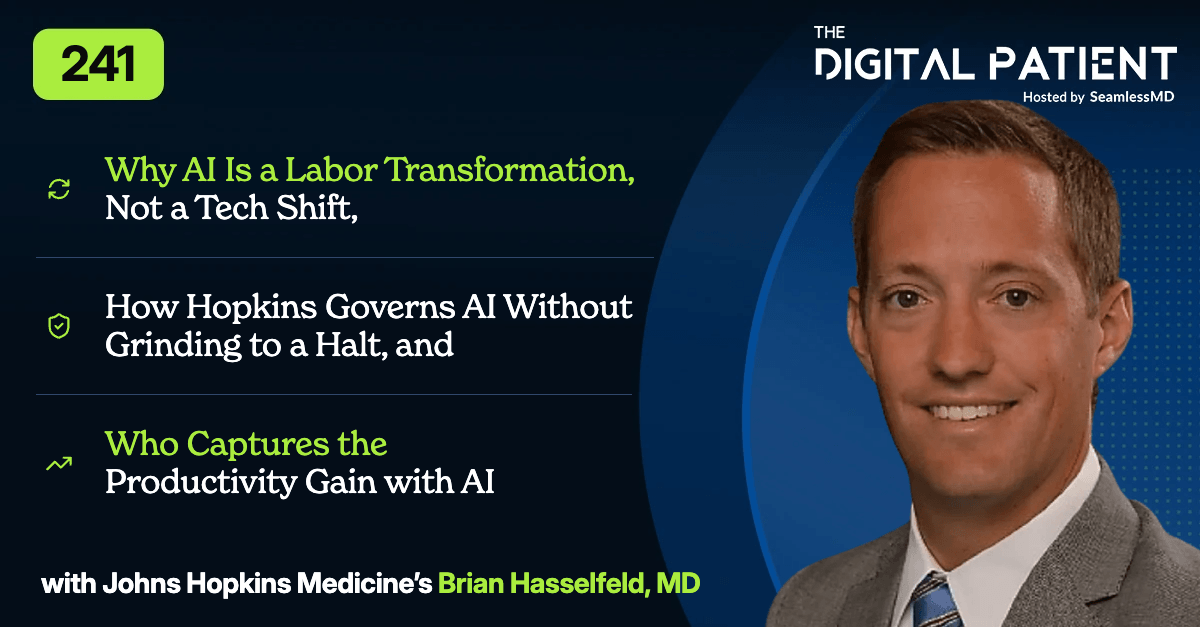
On this episode of The Digital Patient, Dr. Joshua Liu, Co-founder & CEO of SeamlessMD, and colleague, Alan Sardana, chat with Brian Hasselfeld, MD, Executive Medical Director, Digital Health and Innovation at Johns Hopkins Medicine, about "Why AI Is a Labor Transformation, Not a Tech Shift, How Hopkins Governs AI Without Grinding to a Halt, and Who Gets the Productivity Gain with AI, and more..." Click the play button to listen or read the show notes below.
Audio:
Guest(s):
- Brian Hasselfeld, MD, Executive Medical Director, Digital Health and Innovation at Johns Hopkins Medicine
- Joshua Liu, MD (@joshuapliu), Co-founder & CEO at SeamlessMD
Episode 241 - Show Notes:
[00:00:07] Episode preview
[00:04:28] What investment banking taught him about valuing decisions in healthcare — beyond the basic corporate finance toolkit, Dr. Hasselfeld points to the word *value* and the time horizon behind it. "One of my biggest pet peeves in healthcare is our pervasive focus on revenue. And yet, you know, we, no one has any idea about cost."
[00:06:37] How Maryland's global budget model changes what innovation is possible — removing the perceived perverse incentive that more volume and more consumption equals good opens room for different interventions. Dr. Hasselfeld's example is remote patient monitoring, which he says hasn't really scaled in the US because in a fee-for-service world the math never worked: clinical cognitive effort and minutes of time divided by reimbursement. Because Maryland's global budget and all-payer model is hospital-only, Hopkins funds a partnership between its care-at-home team and a clinical home-based monitoring team caring for patients at transition and post-discharge in high-volume conditions like COPD and CHF — without depending on the fee-for-service side.
[00:08:57] Why the same model constrains the capital available to innovate — not all hospitals are the same. Large quaternary centers like The Johns Hopkins Hospital or University of Maryland Medical System can never practically be empty; the wait list at Hopkins Hospital runs to hundreds of people for a 1,000-plus-bed hospital because that's where the complex care has to go. So the hospital runs at full cost, which limits the ability to expand margin into investable capital for more innovative work. "No model's perfect."
[00:11:51] What two shocks changed the pitch he'd make for a digital health role today — Dr. Hasselfeld joined Hopkins in 2019 into a digital role with no precedent, no team and no direct reports, which he got on the strength of his corporate finance background and a really good pitch. He was overseeing a small office of telemedicine in March 2020 when it scaled from a couple of visits a day to 10,000-plus a day within 30 days. That shock is also what moved what he calls nonsensical regulatory and payer barriers. The second shock is the current one.
[00:13:20] Why he frames AI as a labor transformation, not a technology shift — "we look at AI and, and you say artificial, but intelligence is also there." Citing John Larson's comment that healthcare is labor addicted, Dr. Hasselfeld notes that every new clinical, operational or regulatory issue has historically been met by adding people. "And now for the first time, we have a technology evolution that is kind of labor adjacent and potentially labor additive or maybe, potentially replacement."
[00:14:32] Why a fully deregulatory AI environment creates de facto regulation on deployers — Hopkins submitted comments to the HHS AI RFI, co-signed by Dr. Hasselfeld and the CIO. He argues a hands-off environment is pro-innovation, which is good and necessary, but innovation also requires adoption. Absent a regulatory framework, every health system individually has to establish safety, quality, reliability, liability management, and patient and staff education. He draws the parallel to clinicians: centrally funded graduate medical education and a national board exam set a floor that says "good enough," then state licensure and local credentialing customize it. "We're just nowhere close to that yet."
[00:18:00] Why the capacity problem is an economics problem before it's a technology one — returning to his economics roots, Dr. Hasselfeld describes a supply and demand mismatch where consumption would be almost limitless if care were fully available. Healthcare deliberately doesn't let prices float, "but the only other economic outcome is shortage" — three, six, nine, twelve months of waiting, even for primary care. Clinician supply is ten years in the making; PharmD scope, nursing leverage, APP-versus-physician delineation and international pipelines move things only at the margins. "We cannot hire our way out of the amount of care that needs to be provided."
[00:19:59] How an intelligence layer changes between-visit care — Dr. Hasselfeld points to a JAMA research letter using the Epic Cosmos database on trends in messaging and visits, showing continued growth in between-visit messaging that reflects patient demand for connectivity. "But we're not staffed and we don't have the clinical effort to be able to do that." He notes the top reason for burnout is that drawdown on between-visit care time, and sees a real unlock of opportunity in an intelligence layer that first augments and then becomes a truly intelligent colleague helping co-manage.
[00:21:01] The Apple Watch example that shows the scale of the noise problem — Hopkins offers clinician-ordered blood pressure monitoring through Epic's Track My Health, plus native MyChart-to-Apple Watch and HealthKit connectivity. Early on, the integration accidentally started sending heart rates every couple of minutes. "Let's say you have a 2,000-patient panel and you've got 200 easy, you know, at least, that you'd wanna manage for blood pressure. Imagine getting 200 heart rates every few minutes."
[00:24:52] What edge-case testing reveals about AI, capacity and reimbursement — Dr. Hasselfeld tests the question by pushing it to the limit: a 24/7/365 autonomous physician churning out an E&M every ten minutes at infinite scale. "You obviously can't have that... you gotta accept that something's gonna have to change." The harder problem is that healthcare has insurance for everything — unlike gas, oil changes and tires — so productivity or efficiency gains have to be divided between the patient, the third-party intermediary (often the employer) and the system, across cash pay and multiple payers. "The market just doesn't function like that right now."
[00:28:28] How he describes the intelligence layer, using an afferent/efferent analogy — Dr. Hasselfeld resists talking about AI as a single thing; what it looks like depends on the kind of intelligence, kind of labor and operational use case. Borrowing from neurology, he splits the investment into the afferent arm (how you bring data in, both inside the hospital and from patients at home) and the efferent arm (what actually acts), "and in the middle sits that signal noise intelligence layer." He applies it as much inside the hospital as outside, pointing to well-documented alarm fatigue and the reality that clinicians learn to filter pings — "but you will miss something."
[00:33:39] Why novel data sources have to be tied to something clinically valid — Dr. Hasselfeld notes he knows what 15,000 steps a day implies about cardiovascular output, but "I don't know what it means if for 10 straight days you drop to 3,000 steps." His counterexample comes from Hopkins' precision medicine big data work in movement disorders: in MS, accelerometer data — pace, not even steps — tracked relapsing and remitting disease, showing change well before MRI and specialty neurologic exam would pick it up six months later. "If you give everyone a $50 wearable accelerometer and replace every six-month MRI..."
[00:35:15] Why multi-year RCTs can't be the governance model for AI — "Three years down the road, whatever it is you're studying is not only gonna be obsolete, it's gonna be non-existent." Dr. Hasselfeld separates the two questions: establishing what data means can be done through robust, clinically valid research, but governing an intelligence layer that keeps evolving cannot be tied to the RCT cycle. "So that's why we don't have a regulatory framework yet because we don't know what it should be."
[00:36:57] Why liability is a core reason home monitoring never scaled — hard thresholds are easy: systolic above 220, or below 70. The problem is the 90% in the middle, where a patient running a baseline of 160 over 90 drops to 90 over 40, or a post-heart-failure discharge patient has a recovering ejection fraction. "Every patient's context is gonna be different, and so it's that 90% in the middle where that intelligence layer also needs to be able to understand not just the data, but the patient context"
[00:42:47] How Hopkins built AI governance by starting with principles, not process — crediting former CMIO Peter Green, current CIO Deanna Hanish and many others, Dr. Hasselfeld says the group asked what's important to us and what responsible use means before asking how to govern. "Principles without enablement obviously are worth no more than what's on the paper." Enablement meant data readiness, monitoring approaches, and investing in people to actually do the governance, since everyone has a day job.
[00:44:33] The sub-specialized council structure, and what has gone through it — AI is not a monolith, so Hopkins split governance into clinical; imaging (radiology, plus cardiac imaging and digital pathology as image-based disciplines); and operations (revenue cycle, access, call center). Each council mixes IT, clinical informatics, operational executive directors and VPs, frontline staff and leadership so it isn't owned by any one function. About 18 months in, a couple hundred items have come through, with over 70 having a generative AI component — from foundational partners like Microsoft and Epic, from early-stage and mature vendors, and a few built internally. Decisions are majority votes with options to pilot versus scale, require more data later, or monitor and return. They're now layering in low, medium and high risk tiering across counterparty, safety and quality, financial and PR risk.
[00:47:38] How they keep the highest-paid-person's opinion from deciding — Dr. Hasselfeld credits a culture anchored in being an independent investigator-initiated research organization with very strong local autonomy. Co-chairs guide the conversation but don't own it, every vote is equally weighted, and each item comes with a business owner, an IT owner, and an independent council member who turns their input into an internal pitch summary for open discussion. "This is not another FYI meeting that should've been an email." The group has said no to things, piloted things, scaled things, required things to come back, and turned things off — "which, you know, everyone in healthcare knows is maybe even harder than turning things on."
[00:50:24] Why he's urging clinicians to engage with policy right now — the normal regulatory cycle of regulate, watch, wait and iterate is too slow for this moment. "This is moving too fast." Dr. Hasselfeld says policymakers and regulators at both federal and state level, across parties, are being receptive, and encourages any clinician interested in the space to dive in. "I think this is a really important moment in time to ensure that, like, what actually we feel caring for people is heard."
Fast 5 Lightning Round:
- What is your favorite book or book you’ve gifted the most?
Will Guidara's Unreasonable Hospitality - If you could instantly master any skill, what would it be?
"Singing" - Would you rather have Super strength, super speed, or the ability to read people’s minds?
"Super speed" - What is something in healthcare you believe others might find insane?
"No one knows what anything costs." - What is the last movie or TV show you saw, and what did you think of it?
"I have a five-year-old and seven-month-old, so all of my consumption is oriented around mostly what the five-year-old is interested in... So Bluey is on constantly"
The Digital Patient has been recognized as Feedspot's #1 Patient Engagement Podcast of 2025. Thank you to our listeners for making this happen!
.png)
.png)


.png)
