.svg)


July 23, 2026
Subscribe on: RSS | SPOTIFY | APPLE PODCAST | GOOGLE | BREAKER | ANCHOR
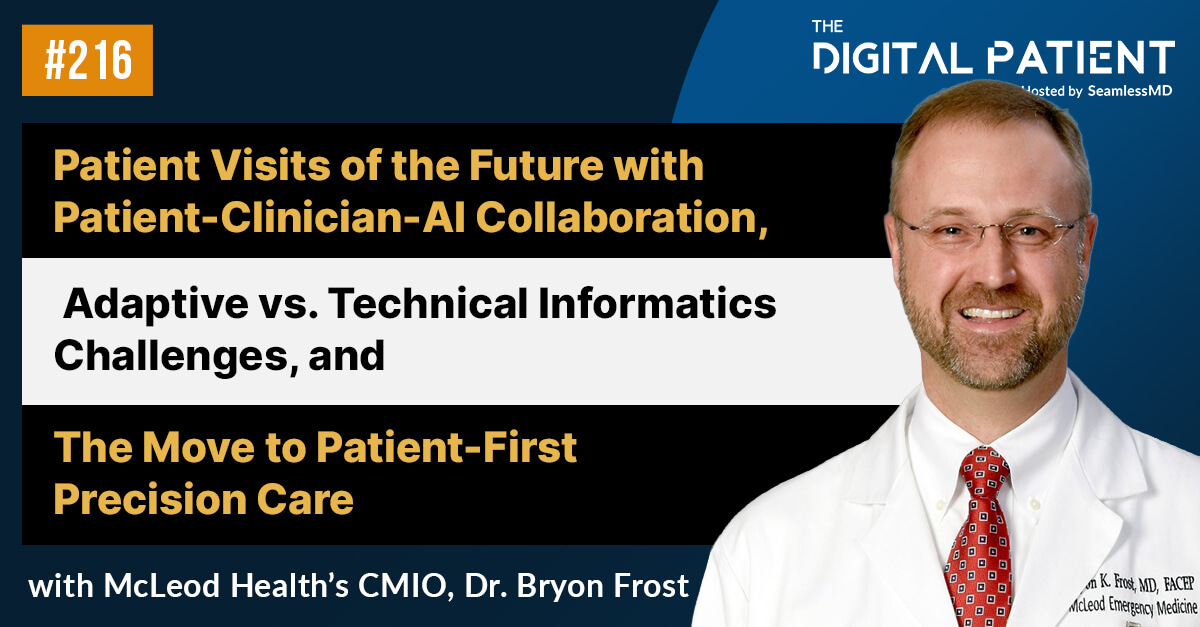
On this episode of The Digital Patient, Dr. Joshua Liu, Co-founder & CEO of SeamlessMD, and colleague, Alan Sardana, chat with Dr. Bryon Frost, CMIO at McLeod Health, about "Patient Visits of the Future with Patient-Clinician-AI Collaboration, Adaptive vs. Technical Informatics Challenges, the Move to Patient-First Precision Care, and more..." Click the play button to listen or read the show notes below.
Audio:
Guest(s):
- Bryon Frost, MD, FACEP, Chief Medical Information Officer at McLeod Health
- Joshua Liu, MD, Co-founder & CEO at SeamlessMD
Episode 216 - Show Notes:
[00:00:07] Episode preview
[00:05:43] Why Dr. Frost’s emergency medicine background makes him “laser focused on efficiency,” lowering cognitive load, and correctly separating adaptive vs. technical problems—while also stressing that informatics success depends on a balanced team, not one person.
[00:09:12] How Dr. Frost reframes “AI” as Artificial Intelligence Augmentation—a tool without metacognition that requires a thought leader—and why safe use requires prompt skill, skepticism, and verification because LLMs optimize for output (not truth) and can produce “confidently inaccurate” results or reinforce user bias through sycophancy.
[00:14:40] What McLeod did instead of blocking all large language models: audit use patterns, educate clinicians, and steer people toward evidence-grounded approaches (including RAG-style systems) to reduce risky, unverified output in clinical contexts.
[00:16:39] Why Dr. Frost believes this AI cycle is different: transformer models unlock unstructured data at scale and are accelerating real-world adoption, including ambient clinical intelligence.
[00:19:00] What Dr. Frost’s “three parties at the table” future looks like: patient, clinician, and a foundation model that supports decision-making—not just documentation—such as surfacing newly available clinical trials.
[00:22:07] How he describes the shift toward precision medicine: combining genomics, microbiome, and family history to treat the person with probabilistic guidance available in the room.
[00:22:41] Why he sees culture as the hardest hurdle: moving beyond paternalism toward patient-first care delivery, including telehealth that fits real life constraints (like not being able to leave work for appointments).
[00:24:54] What excites him about Epic Cosmos: leveraging a massive clinical dataset to enable genetics-informed prescribing, including recognizing when a common medication choice may not be best for a specific patient.
[00:26:05] How McLeod addressed note bloat before ambient: documentation expanded due to billing/coding dynamics and EMR tools, so they built a coalition (compliance, coders, HIM, legal) to reset expectations after CMS guideline retirements.
[00:31:21] The most tangible AI value Dr. Frost sees today: deep machine learning pattern detection (e.g., EKGs and imaging) that can augment clinicians and surface signals humans may miss under heavy workload.
[00:36:03] Why he warns about two AI risks: clinician de-skilling via cognitive offloading (especially early-career) and system fragility, prompting McLeod to run “doomsday” downtime simulations and rethink care delivery without modern tech.
Fast 3 Lightning Round:
- What is your favorite book or book you’ve gifted the most?
Deep Medicine by Eric Topal, Antifragile by Nassim Taleb, and The Theory of Constraints by Eliyahu Goldratt. - Would you rather have Super strength, super speed, or the ability to read people’s minds?
Mind reading. - What is something in healthcare you believe others might find insane?
"That personalized medicine is going to change the way doctors think"
The Digital Patient has been recognized as Feedspot's #1 Patient Engagement Podcast of 2025. Thank you to our listeners for making this happen!


.png)
