Digital Patient Podcast

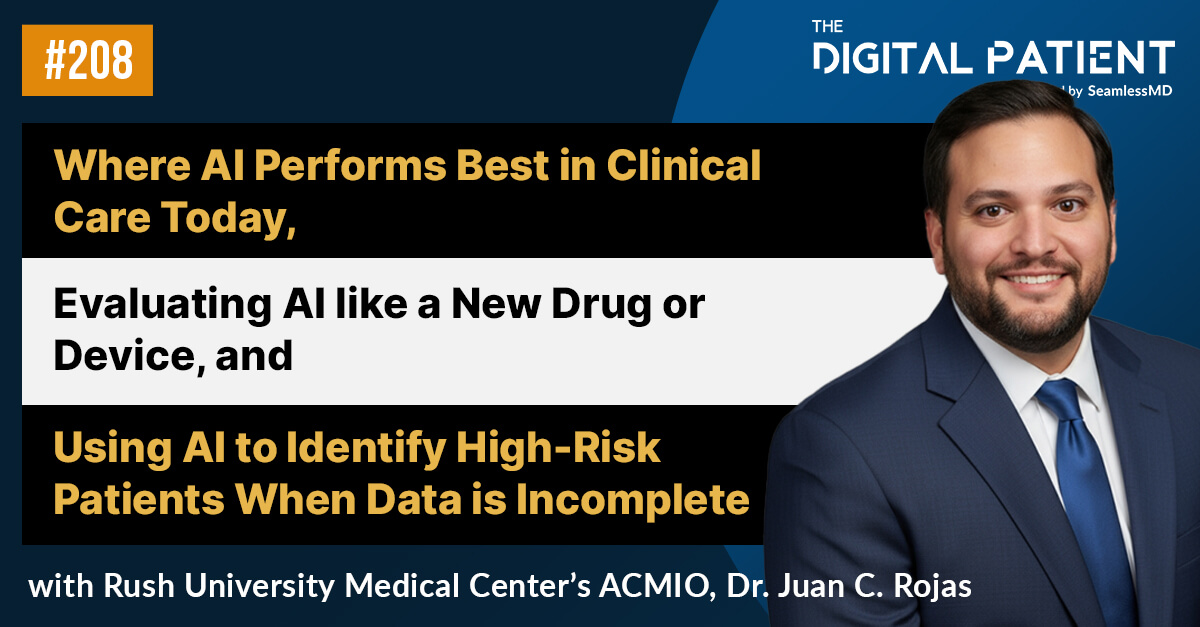
TDP 208: Rush University Medical Center’s ACMIO Dr. Juan C. Rojas: Where AI Performs Best in Clinical Care Today, Evaluating AI like a New Drug or Device, and Using AI to Identify High-Risk Patients When Data is Incomplete

December 16, 2025
By
Seamless

Subscribe on: RSS | SPOTIFY | APPLE PODCAST | GOOGLE | BREAKER | ANCHOR

On this episode of The Digital Patient, Dr. Joshua Liu, Co-founder & CEO of SeamlessMD, and colleague, Alan Sardana, chat with Dr. Juan "JC" Rojas, Associate Chief Medical Information Officer at Rush University Medical Center, about "Where AI Performs Best in Clinical Care Today, Evaluating AI like a New Drug or Device, Using AI to Identify High-Risk Patients When Data is Incomplete, and more..." Click the play button to listen or read the show notes below.

Audio:

Guest(s):

  • Dr. Juan C. Rojas, Associate Chief Medical Information Officer at Rush University Medical Center
  • Dr. Joshua Liu, Co-founder & CEO at SeamlessMD

Episode 208 - Show Notes:

[00:00:07] Episode preview

[00:05:16] Why ICU medicine showed healthcare as a team sport powered by data, technology, and trust.

[00:05:44] How consumer AI like Netflix inspired Dr. Rojas to ask why predictive intelligence wasn’t helping critically ill patients.

[00:06:13] The fellowship project that sparked his informatics career: predicting ICU readmissions to prevent premature discharges.

[00:06:43] Why Dr. Rojas believes AI should function as “augmented intelligence,” supporting clinicians—not replacing them.

[00:08:05] Where AI performs best in healthcare: short-term, physiologic predictions like sepsis and ICU deterioration.

[00:08:51] Why human-driven outcomes like readmissions and length of stay break many predictive models.

[00:10:10] The case for evaluating AI like a drug or device—measuring real-world value, alert burden, and workflow impact.

[00:11:49] The hidden barrier to health equity analytics: inconsistent definitions of race, ethnicity, language, and gender.

[00:12:45] Why health system averages can hide disparities—and how stratified data reveals where care is failing.

[00:14:36] Inside Rush’s AI governance playbook: silent testing, local validation, and equity checks before deployment.

[00:17:34] How Rush uses AI to identify high-risk patients for social needs screening when data is incomplete.

[00:19:24] Why bias and/or imperfect data should not halt progress, as long as health systems actively work to improve fairness over time.

[00:22:37] How ignoring data bias is like skipping hand hygiene.

[00:26:57] Attribution as a major challenge in analytics and why agreeing on definitions before surfacing performance data is paramount.

[00:28:48] The informaticist as a bicycle frame between clinicians and data teams, translating needs across clinical and technical worlds.

[00:33:34] Recounting a failed AI rollout where overlapping scores created confusion, showing how trust and clarity matter more than model accuracy.

[00:37:37] Why AI adoption often fades over time, citing alert fatigue, workflow disruption, and unnoticed system changes that break models.

[00:43:22] Principles for localizing AI models, including silent testing, predefined success thresholds, and strong clinical champions.

Fast 5 Lightning Round:

  1. What is your favorite book or book you’ve gifted the most?
    Not a book, but the Acquired podcast.
  2. If you could instantly master any skill, what would it be?
    "Becoming a full-stack software engineer capable of building production-grade software."
  3. Would you rather have Super strength, super speed, or the ability to read people’s minds?
    Mind reading.
  4. What is something in healthcare you believe others might find insane?
    That healthcare data rights should belong to patients.
  5. What is the last movie or TV show you saw?
    The Diplomat.

The Digital Patient has been recognized as Feedspot's #1 Patient Engagement Podcast of 2025. Thank you to our listeners for making this happen!

TDP 208: Rush University Medical Center’s ACMIO Dr. Juan C. Rojas: Where AI Performs Best in Clinical Care Today, Evaluating AI like a New Drug or Device, and Using AI to Identify High-Risk Patients When Data is Incomplete

Posted by:
Seamless
on
December 16, 2025

Subscribe on: RSS | SPOTIFY | APPLE PODCAST | GOOGLE | BREAKER | ANCHOR

On this episode of The Digital Patient, Dr. Joshua Liu, Co-founder & CEO of SeamlessMD, and colleague, Alan Sardana, chat with Dr. Juan "JC" Rojas, Associate Chief Medical Information Officer at Rush University Medical Center, about "Where AI Performs Best in Clinical Care Today, Evaluating AI like a New Drug or Device, Using AI to Identify High-Risk Patients When Data is Incomplete, and more..." Click the play button to listen or read the show notes below.

Audio:

Guest(s):

  • Dr. Juan C. Rojas, Associate Chief Medical Information Officer at Rush University Medical Center
  • Dr. Joshua Liu, Co-founder & CEO at SeamlessMD

Episode 208 - Show Notes:

[00:00:07] Episode preview

[00:05:16] Why ICU medicine showed healthcare as a team sport powered by data, technology, and trust.

[00:05:44] How consumer AI like Netflix inspired Dr. Rojas to ask why predictive intelligence wasn’t helping critically ill patients.

[00:06:13] The fellowship project that sparked his informatics career: predicting ICU readmissions to prevent premature discharges.

[00:06:43] Why Dr. Rojas believes AI should function as “augmented intelligence,” supporting clinicians—not replacing them.

[00:08:05] Where AI performs best in healthcare: short-term, physiologic predictions like sepsis and ICU deterioration.

[00:08:51] Why human-driven outcomes like readmissions and length of stay break many predictive models.

[00:10:10] The case for evaluating AI like a drug or device—measuring real-world value, alert burden, and workflow impact.

[00:11:49] The hidden barrier to health equity analytics: inconsistent definitions of race, ethnicity, language, and gender.

[00:12:45] Why health system averages can hide disparities—and how stratified data reveals where care is failing.

[00:14:36] Inside Rush’s AI governance playbook: silent testing, local validation, and equity checks before deployment.

[00:17:34] How Rush uses AI to identify high-risk patients for social needs screening when data is incomplete.

[00:19:24] Why bias and/or imperfect data should not halt progress, as long as health systems actively work to improve fairness over time.

[00:22:37] How ignoring data bias is like skipping hand hygiene.

[00:26:57] Attribution as a major challenge in analytics and why agreeing on definitions before surfacing performance data is paramount.

[00:28:48] The informaticist as a bicycle frame between clinicians and data teams, translating needs across clinical and technical worlds.

[00:33:34] Recounting a failed AI rollout where overlapping scores created confusion, showing how trust and clarity matter more than model accuracy.

[00:37:37] Why AI adoption often fades over time, citing alert fatigue, workflow disruption, and unnoticed system changes that break models.

[00:43:22] Principles for localizing AI models, including silent testing, predefined success thresholds, and strong clinical champions.

Fast 5 Lightning Round:

  1. What is your favorite book or book you’ve gifted the most?
    Not a book, but the Acquired podcast.
  2. If you could instantly master any skill, what would it be?
    "Becoming a full-stack software engineer capable of building production-grade software."
  3. Would you rather have Super strength, super speed, or the ability to read people’s minds?
    Mind reading.
  4. What is something in healthcare you believe others might find insane?
    That healthcare data rights should belong to patients.
  5. What is the last movie or TV show you saw?
    The Diplomat.

The Digital Patient has been recognized as Feedspot's #1 Patient Engagement Podcast of 2025. Thank you to our listeners for making this happen!

Recent news from SeamlessMD

TDP 207: BSMH’s Jason Szczuka: Building Coalitions That Actually Move Innovation Forward, The 18-24 Month “Scale or Sunset” Rule for Pilots, and Creating Organization Readiness Through Incentives and Desperation
December 11, 2025

TDP 207: BSMH’s Jason Szczuka: Building Coalitions That Actually Move Innovation Forward, The 18-24 Month “Scale or Sunset” Rule for Pilots, and Creating Organization Readiness Through Incentives and Desperation

Learn More
TDP 206: MHS’ ACMIO Dr. Michael Weiss: Fixing "Rogue" Clinical Notes, Designing Workflows for Rare but High-Risk Events, and Applying Goldilocks Principles to Governance
December 9, 2025

TDP 206: MHS’ ACMIO Dr. Michael Weiss: Fixing "Rogue" Clinical Notes, Designing Workflows for Rare but High-Risk Events, and Applying Goldilocks Principles to Governance

Learn More
TDP 205: Duke Health’s Dr. Eric Poon: Understanding Informatics as a Sociotechnical Team Sport, Co-Creating AI Tools to Promote Accountability, and Why We Must Kiss a lot of Frogs to Find Real Innovation
December 4, 2025

TDP 205: Duke Health’s Dr. Eric Poon: Understanding Informatics as a Sociotechnical Team Sport, Co-Creating AI Tools to Promote Accountability, and Why We Must Kiss a lot of Frogs to Find Real Innovation

Learn More