.svg)


.png)
September 10, 2026
Subscribe on: RSS | SPOTIFY | APPLE PODCAST | GOOGLE | BREAKER | ANCHOR
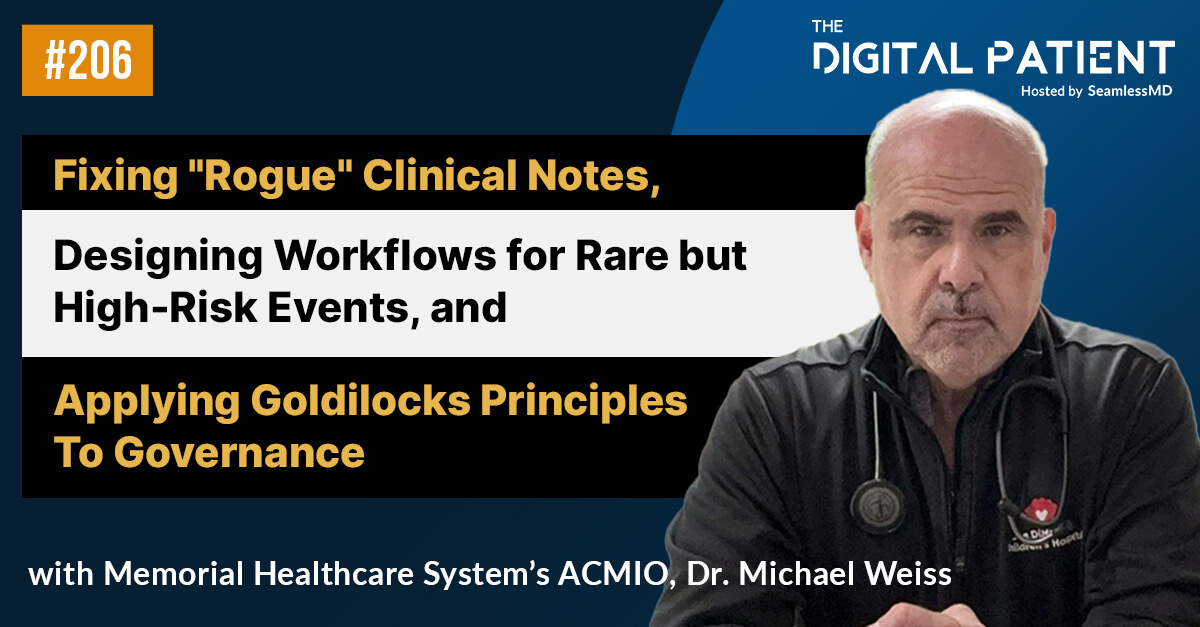
On this episode of The Digital Patient, Dr. Joshua Liu, Co-founder & CEO of SeamlessMD, and colleague, Alan Sardana, chat with Dr. Michael Weiss, Associate Chief Medical Information Officer at Memorial Healthcare System, about "Fixing "Rogue" Clinical Notes, Designing Workflows for Rare but High-Risk Events, Applying Goldilocks Principles to Governance, and more..." Click the play button to listen or read the show notes below.
Audio:
Guest(s):
- Dr. Michael Weiss, Associate Chief Health Information Officer at Memorial Healthcare System
- Dr. Joshua Liu, Co-founder & CEO at SeamlessMD
Episode 206 - Show Notes:
[00:00:07] Episode preview
[00:04:42] Dr. Weiss shares how early exposure to biology, a family rooted in public health, and parallel early interest in computer science shaped his decision to pursue medicine.
[00:06:24] The value of working simultaneously in clinical care and informatics; how each domain strengthens the other.
[00:07:04] Dr. Weiss describes building CPOE for pediatric emergency medicine, achieving 97% compliance through a well-designed single-button workflow.
[00:08:43] Discussing rising cognitive load in modern medicine and the need to better organize and surface data as information volume rapidly expands.
[00:12:02] Dr. Weiss introduces the Rogue Notes initiative to standardize documentation across emergency departments and improve safety, consistency, and billing accuracy.
[00:14:40] How embedding dynamic decision support—such as automated HEART score prompts—significantly boosted compliance and reduced note variability.
[00:18:37] How roughly 8% of "rogue" notes caused 90% of documentation issues, prompting a systemwide rebuild that preserved clinician customization while enforcing required elements.
[00:23:09] Cultural resistance to documentation changes and how transparent conversations, showing data, and addressing emotional impact helped clinicians adopt standardized workflows.
[00:25:18] How ambient AI scribes must complement structured documentation—not replace it—and why humans must remain central to clinical decision-making.
[00:30:01] Concerns around AI tools trying to do too much, overstepping into workflow areas where simpler, well-placed support would add more value.
[00:33:17] Building alerts for rare but high-impact events such as vitamin K refusal, based on a clinical case that highlighted gaps in provider awareness.
[00:38:29] Why each department needs engaged clinical champions who can identify problems, dogfood the EHR, and partner with informatics teams.
[00:40:51] How to apply "Goldilocks" principles to use governance appropriately—knowing when rapid action is safe and when broader oversight across compliance and operations is required.
[00:46:09] The importance of strong foundational data when preparing for AI, warning that excessive customization creates long-term maintenance and safety risks.
[00:49:01] Balancing customization with returning to Epic Foundations as it evolves, always checking whether a standardized tool now better meets the clinical need.
[00:50:01] Encouraging the informatics community to communicate widely to guide AI’s evolution and ensure clinicians remain deeply involved in shaping patient-centered tools.
Fast 5 Lightning Round:
- What is your favorite book or book you’ve gifted the most?
Jonathan Livingston’s Seagull, and Ayn Rand's Fountainhead. - If you could instantly master any skill, what would it be?
"Reading people’s minds… Teleportation would also be high on my list." - Would you rather have Super strength, super speed, or the ability to read people’s minds?
"Mind reading." - What is something in healthcare you believe others might find insane?
"The delivery of healthcare in this country… is mind-boggling." - What is the last movie or TV show you saw?
The Daily Show, Bill Maher, John Oliver, and Foundation.
The Digital Patient has been recognized as Feedspot's #1 Patient Engagement Podcast of 2025. Thank you to our listeners for making this happen!
.png)
.png)


.png)
